Powered By Blogger
Showing posts with label Blockchain. Show all posts

Wednesday, 9 February 2022

Google Exploring Blockchain Products — CEO Shares Web3 Strategies

Google has shared some details of its web3 and blockchain strategies. “As a company, we are looking at how we might contribute to the ecosystem and add value,” said Sundar Pichai, the CEO of Google and its parent company, Alphabet Inc.

Google’s Web3 and Blockchain Strategies

The CEO of Alphabet Inc. and its subsidiary Google, Sundar Pichai, shared some information on the group’s blockchain strategy during the company’s Q4 earnings call last week.

Pichai was asked about his view on web3 and Alphabet’s approach to the industry. “Anytime there is innovation, I find it exciting,” the Google CEO began, elaborating:

On web3, we are definitely looking at blockchain, and such an interesting and powerful technology with broad applications, so much broader, again, than any one application.

“As a company, we are looking at how we might contribute to the ecosystem and add value,” he continued, adding:

Just one example, our Cloud team is looking at how they can support our customers’ needs in building, transacting, storing value, and deploying their products on blockchain-based platforms.

“So we’ll definitely be watching the space closely and supporting it where we can. Overall, I think technology will continue to evolve and innovate and we want to be pro-innovation and approach it that way,” the CEO opined.

Google’s Cloud division recently formed a group to build business around blockchain applications. Richard Widmann, head of strategy for digital assets at Google’s Cloud unit, said the group plans to hire a slew of people with blockchain expertise. “We think that if we do our jobs right, it will drive decentralization,” he was quoted by the media as saying.

The executive added that Google is currently considering what types of services it can offer directly to developers in the blockchain space. Thomas Kurian, Google’s cloud CEO, has identified a number of areas, including retail and health care.

Shivakumar Venkataraman, an engineering vice president for Google, is now running a unit focused on “blockchain and other next-gen distributed computing and data storage technologies,” Bloomberg reported last week.

What do you think about Google’s web3 and blockchain strategies? Let us know in the comments section below.

#AsiaNews #Banking #Bitcoin

#Blockchain #Brexit #Coronavirus

#CryptocurrencyPrediction

#Digital Currency #Forex

#GlobalEconomy #Gold #Legal

#Luno #PiNetwork #StockMarket #StormGain

#WorldNews #HoubiGlobal #RoyalQ #USDT #CryptoExchange 

Thursday, 27 January 2022

Binance to resume SEPA bank transfers in partnership with Paysafe


Crypto exchange Binance has partnered with London-based payments company Paysafe to resume Single Euro Payments Area (SEPA) bank transfers for customers.

Binance temporarily suspended SEPA transfers in July of last year due to “events beyond our control.” Now the exchange has begun rolling out support for SEPA — a system that allows users to make cashless euro payments via bank accounts anywhere in the European Union, as well as several non-EU countries.

"There's a small set of users who will have [SEPA] access today as part of testing before it rolls out to other users across the EEA (European Economic Area)," a Binance spokesperson told The Block.

Paysafe will essentially act as a fiat on-ramps partner for Binance in Europe. The Binance spokesperson said Paysafe has developed a platform for Binance, using both their digital wallet technology and their payment processing capabilities, which will support Binance’s fiat-to-crypto services for users in Europe.

Tuesday, 3 August 2021

AS GLOBAL ADOPTION OF CRYPTOCURRENCY RISES, PAYPAL DECIDES TO HIRE HUNDREDS FOR CRYPTO POSITIONS


As the demand for cryptocurrencies continues to rise along with the soaring adoption rates in financial institutions and organizations across the world, PayPal, which is one of the leading payments giants globally, has decided to hire for more than a hundred positions related to cryptocurrencies. Dan Schulman, who is the CEO and President of PayPal stated that he is very pleased with the momentum with which cryptocurrencies are widely being adopted across the world. Hinting at future endeavours and expansion plans of the company, he also mentioned that PayPal will obviously be adding incremental functionality into the crypto space.

As the company is willing to expand into the crypto space, they are now hiring for more than 100 crypto-related positions in the company that will enhance their crypto services and offerings. According to the job postings on the website of PayPal, there are at least 102 job postings that were about vacancies for positions related to blockchain technology and cryptocurrencies at the time. 

The jobs are mostly for people who are residing in the United States. However there are different positions open in several different countries around the world. These countries include Tel Aviv where there are five different positions open, Ireland where there are six, one position open in Hong Kong, one open in Singapore and there are five openings in Guatemala City for Xoom, the online money transfer service from PayPal.

Majority of the positions are located and are available in the United States. There are twenty-two open positions in California. In New York, there are sixteen, thirteen open positions in Texas, nine positions in Arizona and in Illinois, there are 8. Less than five jobs are posted in each of the few other states. The positions range across different departments. PayPal is looking for crypto engineering managers, strategy managers, program managers, blockchain AML analytics managers, operation managers, investigators, crypto investigations specialists, crypto legal directors and crypto tax reporting managers. 

During the last earnings call, PayPal CEO Dan Schulman outlined several ways in which the payments giant is willing to expand their crypto services. He also talked about launching a “super app”, expansion in the market of the United Kingdom, integration in open banking systems and third-party wallet transfers. 

According to Schulman, the company had garnered huge profits in the first quarter of the year. During the second quarter, he mentioned that, owing to the phenomenal rise in the adoption rate of crypto in financial institutions, organizations and businesses around the world, the company has seen growth rates in their revenue stream that was multiple times higher than what was initially predicted. 

The outstanding rate of business growth in the second quarter of the year has prompted the team to increase the crypto purchase limit to $100,000 on a weekly basis. On top of that, they have also completely eliminated the annual limit for purchasing crypto altogether. Previously the weekly limit was fixed at $20,000 which means that there has been an increase of 5 times that amount, which is a staggering hike. Even the annual purchase limit of crypto was fixed at $50,000 which is completely lifted now since they are offering double that amount not on yearly but on weekly basis. Therefore it is quite evident that the increase that has been made is extremely substantial, to say the least. According to experts, PayPal is looking for dramatic increases in their revenue as the crypto market is proving to be a really great revenue generator for the company. 

PayPal has been planning to extend into the UK market by this month and they are also planning to offer diverse services related to crypto to the global users. As announced by Schulman, they are intending to work on the architectural aspects of the crypto networks and develop the blockchain systems so as to provide optimum user experience during crypto transactions.

There is a rising trend globally among many central banks, regarding Central Bank Digital Currencies or better known as CBDCs, which are basically digital currencies rolled out by Central Banks themselves, and this trend is on a continual rise. So much so that even a year ago, analysts point out that globally there were around 40 banks that were probing into the matter of CBDCs and now that number stands at more than 100 banks, who are interested in adopting the system of digital currencies in future. PayPal wants to use this opportunity to the fullest possible extent and wants to play a pivotal role in the growth and evolution of this new technology. 

Recent reports have suggested that the number of global crypto users have surpassed 220 million in the month of June this year. What is more shocking is that the number had risen from 100 million to 200 million in just a matter of four months.

Wednesday, 21 July 2021

SYGNUM BANK TOKENIZES A PICASSO ARTWORK ON THE BLOCKCHAIN IN CHALLENGE TO NFT

Sygnum Bank, which offers digital and regulated banking for DeFi assets and tokens, has announced that it has partnered with Artemundi to tokenized Picasso’s Fillete Au béret painting.

This is a radical new addition to the blockchain ecosystem with the introduction of what is called Art Security Tokens (ASTs) which are tokens that can be purchased and traded like shares and they mark ownership to artwork and it is broadcast onto the blockchain. This works differently from NFTs in this way and it remains to be seen whether ASTs and NFTs can co-exist in the blockchain artwork industry.

Mathias Imbach, Co-Founder and Group CEO of Sygnum Bank, says, “It has been Sygnum’s mission from the start to empower investors with more direct access to ownership and value. The tokenization of the Fillette au béret exemplifies how we bring our mission to reality, unlocking a universe of unique investment opportunities that can be made accessible to many.”

The painting is valued at 4 million banks and retail and institutional investors would be able to buy ownership of the painting by subscribing to the tokens exclusively through the Sygnum Bank through its e-banking platform and the minimum subscription is 5000 francs. The tokens can be traded on SygnEx which is a digital exchange launched by the bank and the bank also have a CHF stablecoin which can be used for the purchase of the tokens.

The bank believes that the tokenization of the artwork on the blockchain would help to open up the artwork market to a much larger network of users and democratize the whole process. This would also help to connect the buyers and sellers directly without the need for intermediaries and this would help to save costs as well.

This development marks an interesting period for the artwork market which has been an exclusive domain of large investors for many decades. It was ripe for being opened up so that more users would be able to gain access to precious artwork but the fact that blockchain has been the medium that has made it possible would be a surprise to many. Blockchain was connected to the finance industry a lot more than the artwork industry and it is indeed an innovative approach to tokenize the artwork industry and make it accessible for all and the fact that it is being done by a FINMA regulated financial institution would only help to bring in more trust into this new approach.


Monday, 12 July 2021

The Boston Celtics Announce Partnership With Blockchain Company Socios.com


The crypto industry keeps entering into mainstream venues via professional sports leagues, athletes, and teams this year. On Wednesday, the Boston Celtics revealed a partnership with the blockchain provider Socios.com.

Socios.com to Serve as the Presenting Partner of the NBA’s Boston Celtics

On July 7, Socios.com, the blockchain firm that offers fans a chance to be “superfans” allowing them to influence club-specific decisions, trade digital items, and access “ VIP experiences,” has partnered with the Boston Celtics.

The professional team is well known and has won the annual championship series of the National Basketball Association (NBA) 17 times. The announcement reveals that Socios.com will be featured on the web portal celtics.com, according to nba.com’s official announcement.

“[Socios.com will] serve as the presenting partner of the team’s website, placing it at the forefront of the Celtics’ primary hub for relevant news, updates, video highlights, and information pertaining to the franchise,” the Boston Celtics announcement states. “They will also have the ability to leverage the Celtics marks and logos in connection with various Socios.com international marketing activities.”Boston Celtics’ senior vice president of corporate partnerships, Ted Dalton said the deal is always about the fans. “A large part of the Celtics brand is made up of the great fans that support the organization across local, national, and global levels, and we’re excited to find a partner that values fan engagement as much as we do,” Dalton remarked in a statement.

Socios.com claims to have a roster of over 40 major sporting industries like cricket, MMA, esports, soccer, and F1. The blockchain company explained that the partnership with the Boston Celtics is part of the firm’s expansion into U.S. territory.

Socios.com’s deal with the Celtics follows the Portland Trail Blazers revealing the professional basketball team partnered with the cashback blockchain firm Stormx on July 1. Last March, a number of NBA team owners formed an NBA blockchain advisory committee for the American professional basketball league.

What do you think about the deal between Socios.com and the Boston Celtics? Let us know what you think about this subject in the comments section below.

Saturday, 3 July 2021

FTX CLOSES A LONG TERM DEAL WITH GISELE BUNDCHEN AND TOM BRADY


On Tuesday, 29th June, the widespread news of two well-known celebrities to join FTX (a crypto firm) has created excitement among the fans and crypto holders. 


Big names: Gisele Bundchen and Tom Brady, a celebrity couple, have taken a  stake in the well-established crypto firm “FTX ” in a long-term coalition. The pair are being introduced to the most up-to-date universe of digital assets. Both Bundchen, an incredibly famous supermodel, and Brady, a prominent American football player, will fill in as FTX’s ambassadors.

FTX’s founder and chief executive officer, 

Sam Bankman-Fried said in a phone interview that Gisele and Tom are legends, and they have achieved the heights of success in their respective fields. He continued, When it comes to what our firm represents, we like to be known as the most promising product that is out there in the world.

On account of the release, Bundchen will also be taking the position of environmental and social initiatives adviser of FTX. However, the cryptocurrency exchange refused to reveal their capital stake, but it was confirmed that both would receive an anonymous amount and category of crypto.

Celebrity couple’s involvement in the crypto world

The crypto firm FTX, with a robust in-charge of 29-year-old Bankman-Fried, has grown to be the biggest crypto exchange firm in the world. Bankman-Fried said he has talked to other big names as well in the past about potential coalitions; however, When it comes to Bundchen and Brady, they were both indeed into the partnership and were excited about their involvement.

The couple’s ambassadorship shows up as FTX is planning to raise 1 billion dollars in a fresh funding round that could boost its value to 20 billion dollars. However, prime investors have not been named yet, and the conditions of the funding round may change until it’s confirmed. An FTX delegate refused to state anything on the funding round.

Brady has been a supporter of cryptocurrencies. In May, he surprisingly added to Bitcoin’s support when he put a picture of himself with laser eyes ( the remark signifies support for the industry) as his Twitter profile picture.

In a conference with Bankman-Fried earlier this year, Brady also confirmed that he, with his teammates and coaches, had been discussing cryptocurrencies and their changing rates almost every day. 

On Monday, in reference to Bitcoin’s value drop over the previous month, the quarterback for the Tampa Bay Buccaneers tweeted to inquire as to whether anybody had any thoughts as the laser eyes “DIDN’T WORK.” The next day, he posted a video with the caption ” I hear we are headed to the moon?” Where he throws a bitcoin directing toward the moon and it plainly bounced off with a big slam.

Conclusion

In the meantime, FTX has also been bringing in coalitions in other places in the realm of sports. Recently, It has agreed with Major League Baseball and has given the Miami Heat’s National Basketball Association arena its new name as FTX Arena.

Friday, 2 July 2021

Bitcoin of America’s Chief Financial Officer Reports Record Company Growth


PRESS RELEASE. Bitcoin of America (BOA), a popular virtual currency exchange, is reporting record growth. Bitcoin of America is registered as a money services business with the United States Department of Treasury (FinCEN). Their mission is to provide their customers with a fast and easy transaction process, while securing the best rate in the market. The company launched back in 2015 and is headquartered in Chicago, IL. Bitcoin of America is known for their several different services including Bitcoin ATMs (BTMs), Tablets, and online exchange.

Bitcoin of America, one of the leading operators in the industry, has seen tremendous growth this year. Their top line revenue is up 220% and their earnings have increase 8 times the amount of last years. Bitcoin of America is known for their BTMS. They are located in 31 states including major cities across the USA. This year so far, the company has seen a 96 percent increase in BTMs. At the end of January 2021, the company had 630 BTM locations. To date, the company now has 1236 locations. Another aspect of Bitcoin of America that has seen massive growth, is the company’s team. The number of employees grew 32% in just one year.

CEO of Bitcoin of America, Sonny Meraban, is ecstatic about the company’s achievements. “Samantha, our Chief Operating Officer, helped jump start our growth in just a short 16 months. She has truly brought in all of the right people to Bitcoin of America. Paul, our Chief Financial Officer, has been a great addition to our team. He joined Bitcoin of America in January and has already accomplished so much. The rapid growth of Bitcoin of America called for someone with the experience and knowledge of the industry that Paul brings. Meraban also mentioned, “We are not the largest operator yet, but we believe we are the best run operator in the market. From compliance to operations and accounting, we have brought a rational, metrics driven approach so that we can run the business efficiently and profitably.”

Bitcoin of America’s Chief Operating Officer, Samantha Miller is excited about all of the advancements she has seen at the company in just a year. “Since I have started with BOA, I have truly seen exponential growth and we aren’t slowing down anytime soon. Having worked for a startup company in the past this feels like “home”, and I cannot be more excited about what the future holds for us.

Paul Bialobrzewski, Chief Financial Officer, joined Bitcoin of America in January of this year. Bialobrzewski spoke out about the success the company has seen in the last year. “Bitcoin of America has seen impressive growth especially when compared to prior year. The company is well positioned to deliver on the strategic vision the management team has laid out”

In just a year Bitcoin of America added new products and even made updates to their BTMs. The company recognized the high demand for 24/7 customer service and decided to act upon it. Bitcoin of America now offers around-the-clock support on their website.

The company also launched a new point of sale software to their tablet program. This software allows for businesses to start accepting cryptocurrency as a form of payment for their services. Jenna Polinsky, Director of Marketing and Head of Tablet Sales, seems optimistic about the future of Bitcoin of America. “Our new point of sale software will help incorporate cryptocurrency into everyday life. We are excited to offer something that’s free and easy to use. Bitcoin of America offers a great host program that is geared towards businesses that want to get involved in the cryptocurrency industry but are unsure of where to start. I am excited to see where this program goes in the next couple of years.”

Bitcoin of America also launched a new universal kiosk, which combines the capabilities of a traditional ATM with a Bitcoin ATM. There are 3 total functions that these kiosks offer. The first is the traditional ATM feature where customers can dispense cash from a debit card. The second function is being able to buy cryptocurrency with cash. The last is that customers can sell crypto in return for cash. This is huge for business owners. These universal kiosks are bringing stores additional revenue streams, while also saving floor space. Many of Bitcoin of America’s ATMs are placed next to a traditional ATM, often taking up extra room. Now, Bitcoin of America is making it possible to just have 1 machine with all of the same capabilities. You can visit Bitcoin of America’s website to find a location near you or signup as a host!


This is a press release. Readers should do their own due diligence before taking any actions related to the promoted company or any of its affiliates or services. Bitcoin.com is not responsible, directly or indirectly, for any damage or loss caused or alleged to be caused by or in connection with the use of or reliance on any content, goods or services mentioned in the press release.

Beyond Oil™ Launches Smart Contract Driven Eco-Friendly Oil Production


PRESS RELEASE. Beyond Oil™ has officially launched the Solar Oil Project – the blockchain powered decentralized oil production platform that recycles abandoned oil wells to produce oil while eliminating a trillion dollar ecological nightmare.

What the Solar Oil Project does differently:

  • Partners with local oil Operators and green equipment manufacturers.
  • Together, they identify old oil wells that typically produce less than 5 barrels of oil per-day.
  • These wells often become serious ecological hazards when abandoned and leak toxins into the soil and water table. Current clean-up costs are estimated to be over $500billion in North America.
  • SOP token sales are used to fund purchase of new, patented technology to rehabilitate these old wells into profitable, productive sites.
  • This new technology drops cost of production by as much as 50% and carbon footprint by over 90%.
  • The oil production achieved is tokenized and distributed to the token holders that purchased the SOP tokens to make the project possible. Tokenized oil holdings can be traded on the Commodity Exchange technology platform by users at their convenience.

The Triangle Operation

SOP eliminates third-party interference allowing direct interaction between the Operators, Manufacturers, and installers.

SOP connects Well owners, Consumers, and Equipment providers thereby forming a triangle form of partnership. It achieves this by incorporating the blockchain technology that operates on a peer-to-peer protocol.

See how the Solar Oil Project works behind the scenes: https://solaroil.io/due-diligence

The Key Token “SOAX”

This Key utility token to access SOP, is a stake-able token that is run on Smart-Contract protocol. The wonder token grants the users unlimited viewership of the available Oil Properties on the platform, while the users can decide to stake the token (SOAX) on the available properties. This triggers several activities in the business world. The Well owners and operators can maximize the staked amount to improve on the infrastructure and installing the latest modern oil extraction equipment and tools. The Oil that is produced is afterward credited to the Token holders who staked on the project or property.

What Happens With SOAX Token?

The token can be purchased on the platform’s website via multiple payment options including other cryptocurrencies, tokens, and fiat options. Being a non-speculative utility token, it has a fixed value of $0.10 and only functions as the mechanism to allow participation in the oil well rehabilitation and subsequent oil production.

Oil produced from these sites is then tokenized and rewarded to users in proportion of their SOAX token holdings. Solar Oil Production Token (SOPX) represents the oil from the staked properties, whose value is linked to the Crude Oil Prices Globally and set at 60% of the WTI Crude Oil Price. If WTI retails at $50, the price of SOPX is $30. However, this is based on the redemption price that is offered by SOP and not the price within various exchanges. A barrel that is extracted from the SOP contracted properties, is equated to 1 SOPX.

The difference between the SOAX, and SOPX, is that whereas, SOAX can only be purchased from SOP, SOPX token may eventually be offered or traded on various open exchanges thereby becoming The Only Open Decentralized Token that is backed by actual commodity production.

How Smart Contract Comes in

The smart contract checks each portfolio daily to assess the amount produced. The proceeds are then fed to the SOP network for validation. The expected oil production is measured with a metric called ‘BPM’ or ‘Barrels per Million SOAX Tokens’, while its value ranges between 1.5 to 3.5 BPM. This means for every 1,000,000 SOAX staked in the platform, the project expects to produce 1.5 to 3.5 barrels of oil per day. However, the amount is not constant and fluctuates often depending on various factors. The good thing is that the entire process is automated and requires no human intervention. For each barrel, 1 SOPX is created and credited to the stakeholder’s account in proportion to the individual staked amount.

Token holders can sell or hold SOPX Token at the prevailing price and receive BTC or ETH Equivalent. After being sold this way, the tokens are either destroyed or burned to beat market inflation, manipulation, and saturation.

That is how SOP intends to solve the challenges related to oil extraction and production by making sure that every participant gains.

For more Information about SOP, get in touch via https://solaroil.io


About Beyond Oil™

Led by Chief Strategy Officer Hitesh Juneja, aims to transition the energy sector from fossil fuels to more sustainable green energy overtime in a manner that is practical, and does not cause the economic or ecological harm that sudden and forced changes might cause.


Beyond Oil

17918 Blueridge Shores Dr.

Cypress, TX 77433

USA


This is a press release. Readers should do their own due diligence before taking any actions related to the promoted company or any of its affiliates or services. Bitcoin.com is not responsible, directly or indirectly, for any damage or loss caused or alleged to be caused by or in connection with the use of or reliance on any content, goods or services mentioned in the press release.

Dvision Network Open Beta Test (OBT) Goes Live Ahead of Dvision World Launch


PRESS RELEASE. Geneva, Switzerland  Liti Capital SA, a Swiss Litigation Finance company, recently fulfilled their promise to find the con artist that stole $250,000 from a popular YouTube influencer. Less than 48 hours passed from the commitment, indicating the competency of the international investigative team. Liti Capital tokenized the equity in their new company in order to lower the barrier of entry for a wider pool of potential investors. If they are the victims of a crypto scam, token holders will have the option to bring this to the attention of Liti Capital, who will use 5-10% of their funds to pursue such cases.

Many cryptocurrency investors have experienced fraud in their lifetime. The influencer in question, named Joel “Coach K” Kovshoff, fell victim to a particularly inventive and elaborate trap. He is one of the few to tell his story to a wide audience, as these events can be damaging to one’s reputation, and most prefer to keep silent. Kurt Ivy at Splyt caught wind of the video and brought it to the attention of Liti Capital, who then reached out to Joel and learned his story, and then decided to help.

“These guys are acting with complete impunity,” David Kay, international litigator and CIO of Liti Capital said, “They’re so sure they won’t get caught that they don’t even cover their tracks. They don’t think anyone’s coming. Well, we’re coming.” This con artist in particular used a fake identity and fake documentation to create a pseudo-legitimate persona in order to gain Joel’s trust. He also found him in public places and worked hard to befriend him. He mentioned that a company Joel had worked with before, JD Capital, had CertiK available for purchase. When Joal made the purchase, the con artist never completed his end of the transaction.

The Liti Capital, as individuals, have been highly successful in their careers and have experience working all around the world. They and Joel Kovshoff have given the con artist an opportunity to give the money back, with interest. Otherwise, they will take action.

“The same tools we deploy to investigate international cases are the ones we will use to identify and pursue crypto scammers,” Jonas Rey, Co-Founder and Managing Director said, “My team of investigators and intelligence officers have found the con artist in question, his personal information, where the money is, and have engaged with counsel and security at his location. We will give him the weekend to reach out to us.”

Liti Capital uses two tokens, the LITI and the wLITI. The LITI launched Thursday, June 24, 2021, at 11:59 PM EDT. The wLITI will launch on Tuesday, June 29, 2021, at 6:00 PM EDT. Investors may purchase the LITI on the company’s website. The wLITI will be available to be traded for on Uniswap


About Liti Capital

Liti Capital is a Swiss Limited Liability Co specializing in Litigation Finance and FinTech based out of Switzerland. Liti Capital buys litigation assets to fund lawsuits and provide a complete strategic solution along with connections with the best law firm to help its client win the case. Tokenized shares of the company lower the barrier of entry for retail investors, give token holders a vote in the decision-making process, and distribute dividends to token holders upon the success of the plaintiff. Co-Founder Jonas Rey heads one of the most successful intelligence agencies in Switzerland, Athena Intelligence. His two co-founders, Andy Christen and Jaime Delgado bring operational, innovation and technical skills together to round out the leadership team. David Kay, CIO, ran a billion-dollar NYC private equity litigation finance firm before joining Liti Capital.

Visit the Liti Capital website: https://liticapital.com/

Join the Liti Capital Telegram Community

Join the Liti Capital Telegram Announcement Channel

Connect with Liti Capital on LinkedIn

Follow Liti Capital on Twitter

Follow Liti Capital on Medium

PR Contact: masha@cryptoprlabs.com


This is a press release. Readers should do their own due diligence before taking any actions related to the promoted company or any of its affiliates or services. Bitcoin.com is not responsible, directly or indirectly, for any damage or loss caused or alleged to be caused by or in connection with the use of or reliance on any content, goods or services mentioned in the press release.

Free TON DeFi Alliance Announces 15M TON Yield Farming Program


PRESS RELEASE. The 15M TON Yield Farming program will take place on TON Swap (Free TON’s DEX powered by Broxus), except for the WTON-USDT pair which will be both hosted on Uniswap and TON Swap. On June 29 the first stage of farming begins. The second stage is expected to start by the end of the week. The rewards for liquidity providers will be given within two months.

Free TON is a fast, secure and scalable network, which can process millions of transactions per second thanks to its unique dynamic sharding technology. It is on a mission to drive widespread adoption of decentralized solutions by millions of users. Other unique features of Free TON in addition to its infinite sharding paradigm include instant hypercube routing, proof-of-stake mechanics to validate new blocks, an ability to configure network parameters by voting, and many more.

Distribution for the 1st stage

PairPlatformReward within 2 months in TONFarming speed0.84 WTON/sec
WTON-USDTTONSwap4 354 650,0000,84
WTON-USDTUniswap518 400,0000,10
WTON-WETHTONSwap518 400,0000,10
BRIDGE-WTONTONSwap518 400,0000,10
WTON-WBTCTONSwap518 400,0000,10
WTON-USDCTONSwap518 400,0000,10
WTON-FRAXTONSwap518 400,0000,10
USDT-USDCTONSwap518 400,0000,10


Free TON has recently committed to adding $1B in liquidity before the end of 2021. Most of the network’s tokens will be put into Yield Farming in order to attract other significant DeFi protocols as well as to add more liquidity to Free TON and pull more liquidity from Ethereum before the launch of Ethereum 2.0.

This time the Free TON DeFi Alliance has partnered with FRAX (FRAX, FXS) and STASIS (EURS) protocols. The partnership will be advantageous for users of all three networks as it will open up access to highly scalable, stable, and on-chain money with low transaction costs and high TPS.

How to take part in Yield Farming and collect rewards

  1. Install Crystal Wallet for Google Chrome https://chrome.google.com/webstore/detail/ton-crystal-wallet/cgeeodpfagjceefieflmdfphplkenlfk?hl=en
  2. Send TONs to your address in the Crystal wallet
  3. In order to participate in yield farming, you need a pair of tokens, for example WTON-USDT
  4. To turn TON into WTON visit wton.io and exchange TON for WTON one-to-one
  5. To receive USDT in the FreeTON network, you can buy USDT via a trading pair at tonswap.io, or send from ETH to FreeTON via tonbridge.io

5a. Visit https://tonswap.io/swap and exchange the currency you need

5b. Visit https://tonbridge.io/, connect your Metamask and Crystall wallets there and use the ETH-TON tab. Select the token and follow the further instructions on the website.

  1. As soon as there are two tokens on your Crystal wallet in the FreeTON network (for example, WTON and USDT), go to https://tonswap.io/pool and add liquidity to the pair. After the liquidity has been delivered, take your LP tokens (click the cross next to the LP tokens at the bottom of the page), and you will receive the pool LP tokens on your wallet
  2. Go to https://tonswap.io/farming, select the pool corresponding to your pair where you put liquidity and click the Deposit button
  3. Done! After the LP tokens are credited towards farming, you will see your share in the pool and will be able to collect the reward.

Reasons behind Yield Farming and why it’s worthwhile to participate

For the Free TON DeFi Alliance:

1.Firstly, yield farming is a growth hacking technique that creates a positive feedback loop: token subsidies increase returns, returns boost capital inflows, the greater the inflows the bigger the TVL of the pool is, the more efficient way the trades can be executed; more volume is acquired, the more volume the higher the returns. The business will grow by subsidizing the activity / liquidity of users at an early stage, until the operating income for users covers the required profitability for them early on in project development. Thus, by issuing tokens to them, you make early users the beneficiaries of future revenue streams and thereby overcome their reluctance to put liquidity into early protocols.

  1. Decentralization of the network and acquiring new supporters.

For users:

  1. The opportunity to earn outsized returns either in terms of transaction fees or TON Crystal subsidies.

If you experience any difficulties at any stage of the Free TON Yield Farming Program, then visit the Broxus Telegram Chat, and the team will do their best to help you.


This is a press release. Readers should do their own due diligence before taking any actions related to the promoted company or any of its affiliates or services. Bitcoin.com is not responsible, directly or indirectly, for any damage or loss caused or alleged to be caused by or in connection with the use of or reliance on any content, goods or services mentioned in the press release.

Olyseum Launches Experiential NFT Platform to Strengthen Celebrity-Fan Engagement


PRESS RELEASE. Geneva, Switzerland, June 28, 2021 — Olyseum, a blockchain-powered social ecosystem that rewards fan engagement, is excited to announce that it has launched the world’s first star-led experiential NFT (xNFT) platform.

The platform aims to fundamentally change the landscape of fan engagement by taking NFTs to the next level. Olyseum enables gamified, authentic, and meaningful interactions between celebrities and fans.

More than 30 stars with hundreds of millions of combined social media followers had joined the platform even before its official launch, including Olyseum co-founders Carles Puyol and Andrés Iniesta as well as MotoGP star Jorge Martín, motorcycling icon Toni Bou, and 5-star Michelin chef Eneko Atxa.

Olyseum incentivizes the stars through advertising revenue, sponsorships, and the sale of experiential NFTs (xNFTs). Stars use the platform to engage with their fans through content creation activities, skills challenges and experiences. Each star will have their own “solar system”, where fans can enjoy exclusive experiences with them.

Olyseum offers a wide variety of xNFTs for fans to choose from, allowing them to build their own collections, rise up the rankings, and earn exclusive experiences with their favorite celebrities.

Additionally, Olyseum’s native utility token OLY has today been listed on the Gate.io crypto exchange — a leading global crypto exchange by volume — extending its reach to over 4 million users across 150 countries.

Olyseum was founded by the accomplished computer scientist and neuroscientist Carlos Grenoir, who serves as its CEO, and the globally renowned cybersecurity consultant Kevin Mitnick. Other founding members are the former FC Barcelona players Carles Puyol, Andrés Iniesta and Iván de la Peña.

Commenting on the launch, Olyseum co-founder and CEO Carlos Grenoir said: “In today’s highly charged social media landscape, fans have huge visibility over their favourite stars’ activities, but interaction levels are extremely limited and lack any real substance. While the rapidly expanding NFT space is providing fertile ground for stars to develop high-value digital representations of their content, the fan-star experiential paradigm has yet to be properly explored, until now.

Olyseum wants to redefine the parameters of fan engagement, empower fans to have their fandom validated, broaden the accessibility of authentic star experiences, and create a venue for xNFT trading and renting. We’re also giving stars the chance to enrich existing NFTs and transform them into xNFTs on our platform. With our unrivalled network of international icons, Olyseum’s xNFT platform is in prime position to become the marketplace of choice for stars and fans alike, while providing a trusted environment for stars to debut in the crypto sphere, elevate their brand, and monetize their star power.”

Olyseum counts among its key investors the Crèdit Andorrà Bank, BuyVIP co-founder Gerald Heydenreich, former Rothschild senior advisor Javier de Rocafort, super hacker Kevin Mitnick, INDITEX partner Jordi Ballbe, and former FC Barcelona players Carles Puyol, Andrés Iniesta and Iván de la Peña.

Olyseum’s leading token holders are Jehan Chu, founder of Kenetic Capital and co-founder of Social Alpha Foundation; Patrick Dai, founder of Qtum; David Garcia, founder of Borderless Capital and Ripio; and Albert Castellana, co-founder of NEM foundation.

OLY is an ERC-20 based token. It was launched on Uniswap in February. The token has been listed on the Gate.io exchange, ProBit exchange, CoinMarketCap, CoinGecko; and has been integrated into the Oxis and Monedero wallets.

About Olyseum

Olyseum is a star-led rewards platform for experiences and enriched Non-fungible Tokens (NFTs), making it more accessible and monetizable by taking non-fungible tokens to the next level. Olyseum’s expanding roster of stars are aligned on a common mission to create opportunities for meaningful, authentic interactions with fans, and rewarding fans for their support and participation in the celebrity economy. For more information, pleasevisitolyseum.comolyseum.medium.com and https://olyseum.zendesk.com

World Wide Web Inventor Tim Berners-Lee Sells NFT for $5.4M — 'Embarrassing' Coding Error Spotted in NFT


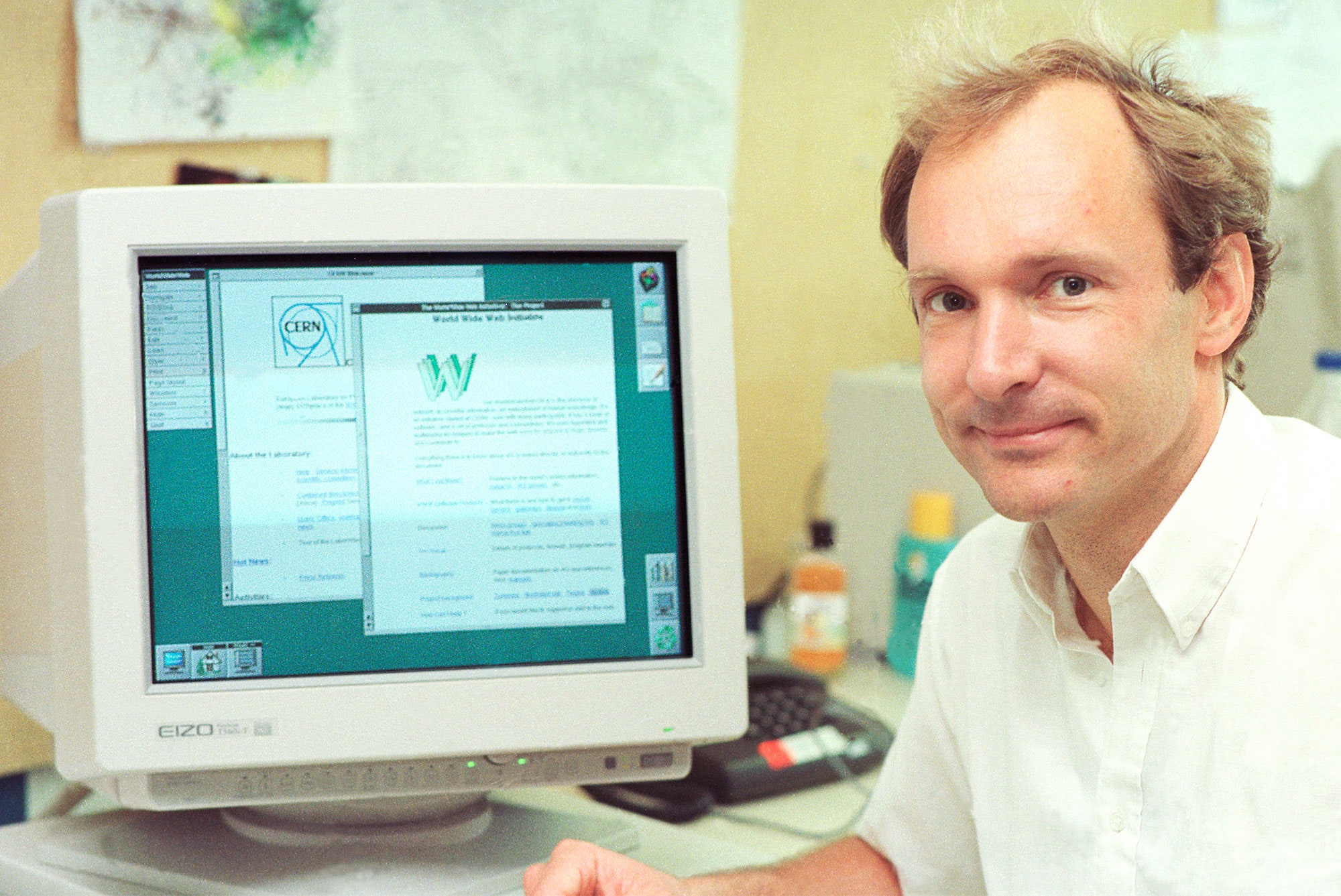
Sir Timothy John Berners-Lee, the English computer scientist who is well known for inventing the world wide web has sold a non-fungible token (NFT) in an online auction hosted by the auction house Sotheby’s. The NFT is basically a video of the World Wide Web’s source code created in Python and the collectible sold for $5.4 million.

Tim Berners-Lee and Sotheby’s Auction NFT for $5.4 Million

This week, Sotheby’s revealed that Tim Berners-Lee sold an NFT of the original source code for the world wide web for a whopping $5.4 million. Before the NFT auction, Berners-Lee told the publication the Guardian: “I’m not selling the web – you won’t have to start paying money to follow links. I’m not even selling the source code. I’m selling a picture that I made, with a Python program that I wrote myself, of what the source code would look like if it was stuck on the wall and signed by me.”

World Wide Web Inventor Tim Berners-Lee Sells NFT for $5.4M — 'Embarrassing' Coding Error Spotted in NFT
Sir Timothy John Berners-Lee, the English computer scientist who invented the world wide web.

Berners-Lee invented the web in 1989 and before the NFT sale he said “The core codes and protocols on the web are royalty-free, just as they always have been.” A representative from Sotheby’s said the non-fungible token collectible art auction was historical and the fact that Berners-Lee verified the NFT makes it even more valuable.

“The symbolism, the history, the fact that they’re coming from the creator is what makes them valuable, and there are lots of people who collect things for exactly those reasons,” Cassandra Hatton, the global head of science and popular culture at Sotheby’s explained in a statement. “We have placed it in a public forum, we have sold it at basically no reserve and we let the market decide what the value is going to be. There have been multiple bidders who have all agreed that it’s valuable.”

Berners-Lee is well respected for his contribution to today’s online advances and in 2018 he announced a project aimed at decentralizing the web. “For all the good we’ve achieved,” Berners-Lee said at the time. “The web has evolved into an engine of inequity and division; swayed by powerful forces who use it for their own agendas,” he added. The inventor of the web had also reported on bitcoin on various occasions during the crypto asset’s earliest years.

Coding Error Spotted – Researcher Says There Have Already Been Discussions of a Misprint Error

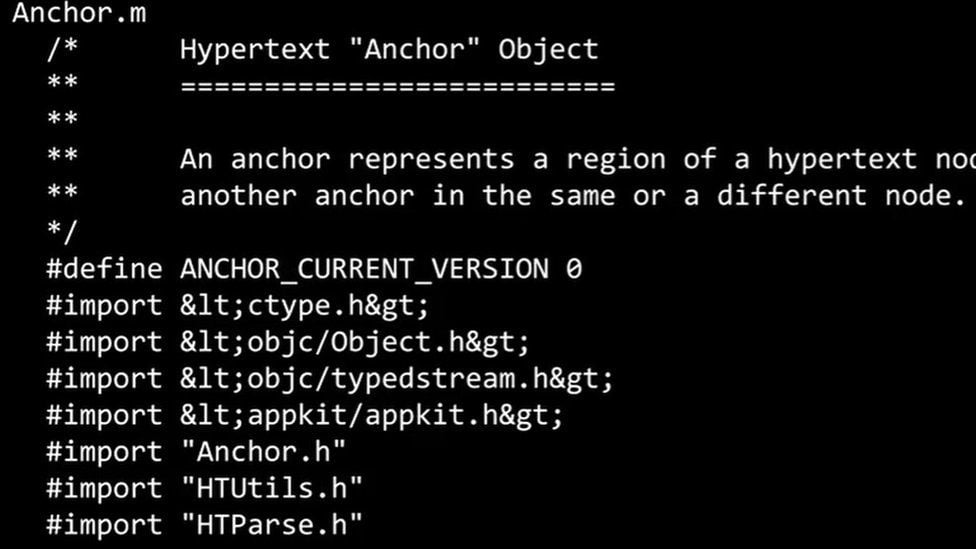
Following the Berners-Lee NFT sale, a coding error was spotted in the NFT video that sold for £3.9 million ($5.4 million). The researcher that spotted the error in the video told BBC News it looked like “a simple mistake.” Mikko Hypponen explains that certain symbols were translated into HyperText Markup Language (HTML) and he believes it was an error.

World Wide Web Inventor Tim Berners-Lee Sells NFT for $5.4M — 'Embarrassing' Coding Error Spotted in NFT
The error spotted by the researcher – screenshot taken by BBC News, an operational business division of the British Broadcasting Corporation.

“There have already been discussions about whether this would make the NFT more valuable – like a postage stamp with a misprint error,” Hypponen said.

Moreover, website creator Mark O’Neill told the BBC that “whoever made the video for the website ran the original text file through something that converted it into HTML. It’s embarrassing for Sotheby’s but I trust that nobody has done the same to the original code,” O’Neill added.

The BBC’s report notes that the newsdesk had reached out to Sotheby’s and Tim Berners-Lee for comment.

What do you think about Tim Berners-Lee selling an NFT for $5.4 million with an error? Let us know what you think about this subject in the comments section below

Thursday, 1 July 2021

Triall: Bridging the Gap Between Medical Research and Blockchain Technology


The COVID-19 pandemic has ravaged the global economy, leaving many industries re-evaluating the robustness of legacy models in times of crisis. Unsurprisingly, one of the most impacted industries has been the global healthcare industry, as governments raced to test for, treat and develop a vaccine for the fast-spreading virus. Whilst, on the whole, the testing regimes, treatments and vaccination programs have been somewhat successful in developed countries (especially the United Kingdom and Israel), existing pain points in pharmaceutical research and development have exacerbated delays according to a number of experts.

Namely, the clinical trial industry, a sector responsible for testing the safety and efficacy of new vaccines and therapeutics before these enter the market, is currently hampered by various inefficiencies. The pandemic has exemplified the need for solutions to tackle these inefficiencies and thereby help ensure an efficient influx of new medicines.

This is where Triall enters the scene.

Triall is building a global digital ecosystem for clinical trials. Capitalizing on both the rapid digitalization of healthcare and the technological advances in the blockchain and crypto space, Triall is applying blockchain-based technologies to a sector that has become increasingly complex, data-heavy and fragmented over the past decade.

Increasing Costs and Longer Development Timelines

Clinical trials are integral to the healthcare industry’s response to new and existing diseases and viruses. They involve a number of industry stakeholders, including pharmaceutical companies, contract research organizations, and hospitals, as well as external parties such as governments and regulators.The clinical trial industry plays a crucial role in ensuring that society’s unmet medical needs can be addressed, inside and outside of crisis situations like the COVID-19 pandemic.

However, the clinical trial process is currently fraught with complexity and resource-inefficiency which artificially lengthens development timelines. There are several notable reasons for this, including:

  • Fragmentation: Data is scattered across sites and systems.
  • Oversight issues: Clinical trial professionals experience a lack of oversight over their clinical trial processes and activities.
  • Inefficient record-keeping: There is no efficient and universal way to manage and store data, causing significant delays and safety risks, as well as increasing costs.
  • Data integrity issues: There are a growing number of data integrity issues being uncovered during clinical trial inspections according to the World Health Organization (WHO).
  • Low patient engagement: As much as 85% of trials fail to retain enough patients which also leads to costly delays.

Indeed, the data show that these problems are only getting worse, with the cost of clinical trials increasing up to 9% per year on average. More shockingly, the sector suffers from a development success rate of just 11%.

Upgrading Global Healthcare with Technology

Triall’s innovative new platform is laser-focussed on resolving these critical issues and shortening the time to market of new medicines. The company is building a global ecosystem for clinical research professionals that crosses organizational boundaries and domains. Participants in the platform include: clinical research professionals, medical staff, patients and software developers, as well as other contributors and maintainers such as blockchain engineers and node operators.

Fundamentally, the platform allows for the efficient exchange of clinical trial data leveraging blockchain-enabled technologies and open standards for identity and access management. Triall will implement Decentralized Identifiers (DIDs) and Verifiable Credentials (VCs) to integrate the severely fragmented landscape of industry stakeholders in the clinical trial sector. As a result, Triall’s platform will ensure clinical trials can be conducted smarter, safer and more-efficient due to more closely integrated workflows.

Speaking about Triall’s driving philosophy, the company’s CEO, Hadil Es-Sbai had this to say:

“We believe state-of-the-art Information Technology and scientific insights make a difference. Our passion lies in advancing clinical development, consolidating the unconnected, and fostering a global ecosystem that promotes trust and reliability throughout all phases of clinical development.”

The Future of Clinical Trials

Combining this driving philosophy with the rapid digitization trends resulting from the pandemic, Triall is positioned to take a leading role in revolutionizing the clinical trial space.

In addition to its unique approach, Triall also leverages a breadth of experience in the field. The Triall team has managed over 100 clinical trials in more than 30 countries. Accordingly, the company has curated a strong and global network of stakeholders that will be instrumental to driving its platform’s development. Moreover, with 250+ peer reviewed papers published in various top-tier scientific journals, Triall also brings a wealth of academic knowledge, combining academic experts from several medical disciplines that support the shaping of its platform’s features. These include experts on topics such as immunology, infectious diseases, vaccinology, microbiology, eHealth technologies, drug and vaccine development.

Finally, Triall is already more than just a proof of concept. Its first application Verial eTMF, a blockchain-integrated document solution, was piloted in the summer of 2019. According to the team, this was the world’s first implementation of blockchain in a live and running clinical trials. The commercial version of Verial eTMF is now being onboarded in 6 clinical trial projects around the world. Indeed, this serves as the ultimate mark of validation, from both the market and industry.

For more info on how Triall is bridging the gap between the healthcare and crypto domains, visit their website here

The Cryptocurrency Whale Phenomenon: How do Investors thread Volatility Splashes?


Cryptocurrencies remain extremely volatile. Bitcoin is consistently on track for topping their biggest monthly increase and decline. It faced one of their record-highs of 37.5% decline just this May 2021, and frequently sees drops like 37% drop seen in November 2018 and 40% slide in September 2011. Most recently, the price of bitcoin climbed to $34,805.19 Monday 28th June 2021, up 8% from where it stood at 5 p.m. ET Friday, after Mexican billionaire Ricardo Salinas Pliego encouraged its purchase. This volatility serves as a double-edged sword, both as an exciting asset choice for some investors and apprehension for others, preventing widespread adoption.

One contributing factor to volatility is that the crypto markets have an abundance of whales – a term given to someone who holds a significant amount of a particular asset; someone who holds a minimum of 1,000 Bitcoin is considered to be a whale. The sheer size of their holdings means that, when they decide to sell, the market is suddenly flooded with this asset, causing big price movements.

These powerful investors exist across all asset classes, but cryptocurrencies are particularly vulnerable because there are more whales, but much smaller volumes and less liquidity across a fragmented sea of exchanges. Without sufficient liquidity, these whales are trapped in a proverbial swimming pool, destined to send huge waves through the market as soon as they move. Because each exchange is segregated into their small swimming pools of liquidity, they are incredibly susceptible to whale movements.

For that reason, we need to solve the liquidity problem by joining all these segregated small swimming pools into one big ocean. The trading technology of the crypto market has not yet caught up to the maturity and stability of forex, which employs OTC trading, which is how it minimizes the effects of large buy and sell orders that can drastically move the market. If the crypto market integrates that, this can dramatically improve crypto exchange liquidity and stabilise pricing as a result. It’s time to deepen the liquidity pool.

The influence of whales

Cryptocurrency assets are still fundamentally very concentrated. The sudden growth of Bitcoin means that a large portion of the market is owned by a small majority of traders who were fortunate enough to buy lots of Bitcoin when the price was low. Currently, around 40% of Bitcoin is held in around 2,500 accounts.

The same is true of altcoins. For example, it was revealed in February this year that one person holds 28% of Dogecoin, which has soared by almost 1,400% since the start of the year. An individual in possession of that large a proportion of the market has a huge effect on the price.

And the effects of these whales are visible. When whales are selling, the prices of cryptocurrencies are on a downward spiral. On April 18th, for example, one trader moved 58,814 BTC – worth more than $3.3 billion at the time – from Binance to a private wallet at the same time as the prices slid to a low of $51,541 per unit.

While whales are clearly affecting the price of Bitcoin, their influence is greater among altcoins, which have lower market caps and are less liquid. Not long ago, the price of Ethereum plummeted by more than 50% on the Kraken Exchange, plunging from $1,628 to $700 within the space of minutes.

The CEO of Kraken attributed this to single sell, saying “it could be that a single whale just decided to dump his life savings.” For Ethereum to drop $1000 dollars in three minutes is extraordinary and it proves that even the biggest exchanges with large volumes can be rocked by big whale movements.

Shrinking liquidity

Considering price swings are compounded by fragmented liquidity, the market must pay attention to the fact that liquidity is getting worse, not better. The amount of Bitcoin on exchanges is down 20% over the last 12 months. Slowly but surely, liquidity is drying up and the pool is getting smaller.

The bullish cryptocurrency market means people are holding the asset, simply watching the price tick up. Evidence suggests that there is a growing number of whales, with the number of individual holders of over 1,000 Bitcoin at an all-time high of 2,334. So, despite growing popularity, there is still only a very limited amount and diminishing amount of cryptos changing hands.

Contributing to these problems, big investors are entering the crypto market in swathes. Institutional investors, hedge funds, high-net worth individuals, and companies – most famously Tesla – are all looking to hold and trade crypto assets. And with more buying power, it is likely to increase order sizes and add to the influence of whales.

We cannot prevent these big players from influencing crypto trading, but solutions for the underlying lack of liquidity that exacerbates price swings exists.

Unifying the pool

To combat whale-induced price swings, the market is slowly adopting tactics from other asset classes. For example, many OTC brokers are targeting crypto whales to trade digital currencies over the counter because they can access more liquidity than exchanges.

However, for a lasting solution that can cushion large orders and prevent sudden and drastic price changes, exchanges should turn to trading technology that has been mastered in other markets. For example, the FX markets have long provided Straight-Through-Processing capabilities on a global liquidity network, where orders are aggregated and processed using Smart Order Routing. This infrastructure allows global price discovery, where the best bid and ask prices are presented to all market participants, regardless of trading avenue.

Effectively, it allows exchanges to leverage the liquidity of other exchanges, including from the biggest in the industry. Using this model, exchanges can consistently provide traders the best prices and absorb the impact of big whale splashes by drawing on liquidity from the wider market. The multiple individual pools join to become an ocean.

Only once these issues are addressed will cryptocurrencies be free of the volatility that comes with so many big fish in a market lacking depth.

Wednesday, 30 June 2021

Coinbase Approved to Enter German Cryptocurrency Market


Cryptocurrency exchange Coinbase has obtained approval from Germany’s financial regulator, Bafin, to provide cryptocurrency trading and custody services. Coinbase Germany will launch in the coming weeks.

  • Coinbase, a Nasdaq-listed company, announced Monday that it has secured a cryptocurrency license in Germany.
  • The company explained: “The German Federal Financial Supervisory Authority (Bafin) has awarded Coinbase Germany GmbH a license for crypto custody and trading, under the new licensing regime introduced in January 2020.”
  • According to Coinbase, the Bafin licensing framework is the first of its kind in the European Union and Coinbase Germany is the first company to be awarded such a license.
  • The announcement adds:

Coinbase Germany will launch in the coming weeks to serve both new and existing German customers more effectively, including by localising our service and increasing our product offering.

  • In preparation for the launch, the company is ramping up its German customer support team.
  • Coinbase said that it had been working closely with Bafin for many months prior to obtaining the license.
  • Recently, Coinbase also obtained approval to operate in Japan from the country’s top financial regulator, the Financial Services Agency (FSA).

What do you think about Coinbase getting a license to operate in Germany? Let us know in the comments section below.

Tuesday, 29 June 2021

Myriad Proof-of-Work Blockchains See Significant Hashrate Losses


While there’s been a lot of concentration on bitcoin mining crackdowns in China and Bitcoin’s recent hashrate loss on Monday, many other digital assets have seen hashrates drop significantly as well. Some of the largest digital currencies, in terms of market valuation, lost considerable dedicated hashpower over the last few days.

PoW Chains Feel the Wrath of the Great ASIC and GPU Exodus

Lots of crypto advocates have been focused on China and Bitcoin’s (BTC) hashrate losing a large percentage of hashpower. Data shows on Monday, June 28, that BTC’s hashrate did drop considerably, but intraday statistics are not as reliable as they will be in five to seven days.

Myriad Proof-of-Work Blockchains See Significant Hashrate Losses
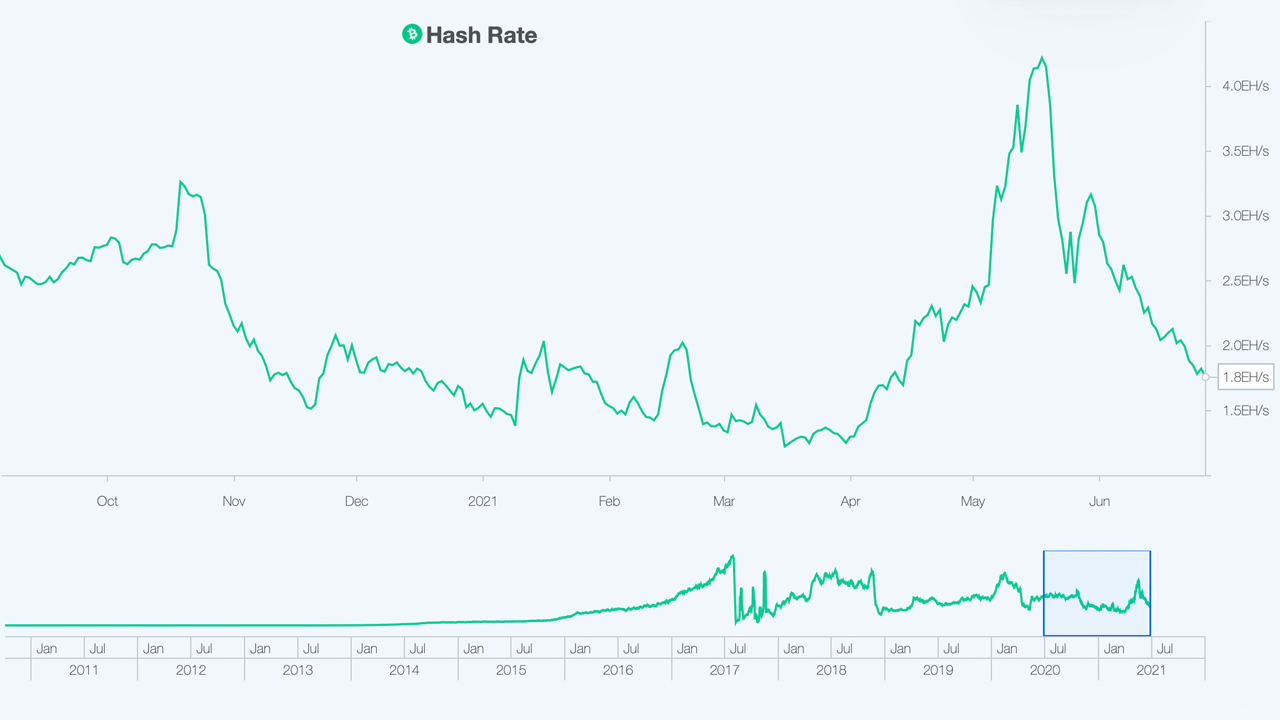
Bitcoin Cash hashrate on June 28, 2021.

Estimates show BTC’s intraday hashrate drop was over 35% but this metric may be recorded differently by the end of next week. There’s been a huge focus on the BTC chain’s hashrate, but no one’s talking about a large number of other blockchains that secure their networks using proof-of-work (PoW) losing considerable hashpower as well.

For instance, on Sunday, June 27, Monero’s (XMR) hashrate was around 2,580 megahash per second (MH/s) or 2.58 gigahash per second (GH/s). The following day, XMR’s hashrate slipped to 2.36 GH/s losing 8.52% of its intraday hashrate.

Hashrate on the Bitcoin Cash (BCH) chain was above 2.5 exahash per second (EH/s) during the first week of June. Nevertheless, on June 22, it dropped to a low of 1.15 EH/sBCH hash has jumped back some, and hovers just below the 2 EH/s region at time of writing.

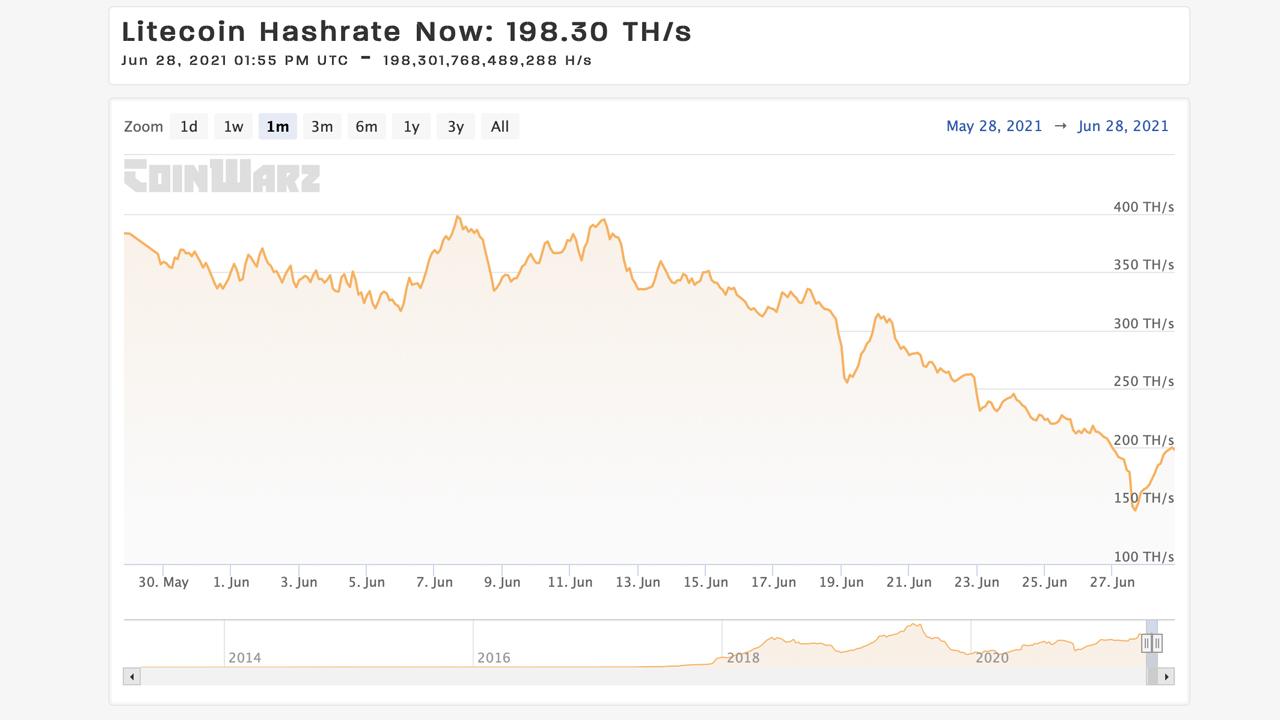
On Saturday, June 26, Litecoin’s (LTC) hashrate was around 218 terahash per second (TH/s) and it slid to a low of 145 TH/s on Monday morning (EDT). LTC’s hashrate has kicked back up to 197 TH/s, but it’s still down 9.63% since Saturday.

Myriad Proof-of-Work Blockchains See Significant Hashrate Losses
Litecoin hashrate on June 28, 2021.

Dash had 6 petahash per second (PH/s) on Sunday afternoon, but on Monday the DASH hash rate was down 34.5% intraday at 3.93 PH/s. Hashrate has dropped on the Ethereum (ETH) blockchain, Ethereum Classic (ETC), Zcash (ZEC), and many other PoW chains.

Some consider blockchains like Dash’s consensus mechanism a modification of the proof-of-stake (PoS) and PoW algorithm, because the chain also leverages masternodes and LLMQ-based Chainlocks. The Ethereum chain is also in the midst of transitioning to a full PoS chain but it also uses a mixture of PoW at the moment.

Myriad Proof-of-Work Blockchains See Significant Hashrate Losses
Ethereum hashrate on June 28, 2021.

While these coins do use PoW, they leverage different consensus algorithms, which means different application-specific integrated circuits (ASIC) and graphics processing unit (GPU)-driven machines are needed to mine these coins.

BTCBCH, and BSV all share the same SHA256 algorithm but there are many other PoW algorithms like Scrypt (dogecoin, litecoin), Randomx (XMR), Ethash (ETH), Blake (DCR), X11 (DASH), and Equihash (ZEC). Since the crackdowns in China, any coin with a hashrate pulse has felt the pressure of the great ASIC and GPU exodus.

What do you think about all the crypto asset networks that have lost considerable hashrate in June? Let us know what you think about this subject in the comments section below.

Sunday, 27 June 2021

Blockchain Surveillance Firm Chainalysis Raises $100 Million, Company's Valuation Now $4.2 Billion


The blockchain intelligence and surveillance firm Chainalysis announced the company has raised $100 million in Series E funding from investors such as Coatue, Benchmark, Accel, Addition, Dragoneer, Sequoia Heritage, and SVB Capital. The financing brings the company’s valuation to $4.2 billion and it aims to expand its resources and deepen data to cover more cryptocurrencies and focus on use cases like decentralized finance (defi).

Chainalysis Raises $100 Million, Blockchain Intelligence Firm’s Valuation Now Over $4 Billion

The blockchain Satoshi designed is a transparent ledger and transactions can be traced all the way back to the genesis block. This doesn’t necessarily mean, however, that a person can pinpoint with accuracy the identity of the individual or organization behind a cryptocurrency transaction.

Nevertheless, this data does help an investigator get closer to that answer. In Bitcoin’s early days, blockchain surveillance was mostly nonexistent, but a few years after the network effect gathered momentum it became much more prevalent.

There are now over two dozen blockchain intelligence and surveillance firms and over the years these companies have upped the stakes by monitoring dozens of blockchains besides Bitcoin. They have also raised millions of dollars from investors and government contracts.

On June 24, the firm Chainalysis revealed it had raised $100 million from investors and it aims to expand operations a great deal. Chainalysis launched in 2013 and the company provides blockchain data to governments, institutions, and exchanges in over 60 countries. The company’s $100 million raise bumps Chainalysis up to a $4.2 billion valuation. The Series E funding round was led by Coatue.

Blockchain Surveillance Firm Chainalysis Raises $100 Million,
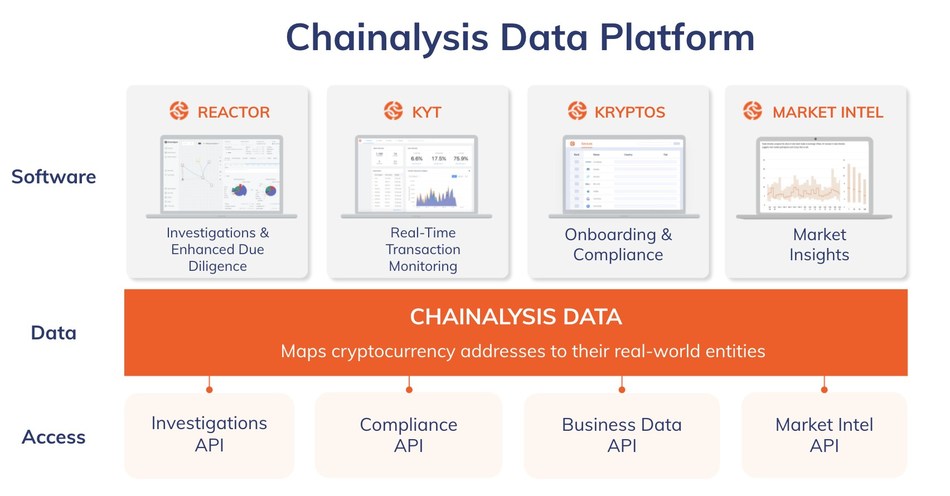
Chainalysis Data Platform

The Series E follows the $100 million Series D round the company raised in March 2021, and the funds will be used to expand services across the board. Three expansion concentrations are mentioned in the announcement which include deepening data. This would entail monitoring more cryptocurrencies and a focus on defi. Software is next on the list as Chainalysis aims to create software solutions for both the public and private sector.

Lastly, Chainalysis said it would provide more access via the use of APIs so “government agencies, financial institutions, and cryptocurrency exchanges” can leverage the firm’s data. The company has competition from the likes of well-known blockchain intelligence firms like Ciphertrace and Elliptic.

Other firms involved in the analytics and blockchain monitoring field include organizations like Sixgill, Tibco, Credits, Crystal Blockchain, Dune analytics, Madana, Bitrank, Ocyan, Alethio, Bison Trails, Blockpit, Blockmonitor, Bloxy, Postchain, and Scoreshain. Chainalysis’s Series D and E rounds bring the total amount raised by the firm to $365 million.

Blockchain analysis has been big business all across the globe and governments and law enforcement agencies have paid big money for these services. Between Chainalysis and Ciphertrace alone, it was estimated that in 2019 more than 80% of the cryptocurrencies in existence were tracked by blockchain surveillance.

What do you think about the blockchain surveillance firm Chainalysis raising $100 million? Let us know what you think about this subject in the comments section below.