Powered By Blogger

Thursday, 1 July 2021

Formula 1 Secures Multimillion Crypto Sponsorship Deal


Formula 1, the international auto racing organization, has found a new sponsor from the crypto industry. The long-term deal will provide a digital asset trading platform with brand presence at F1 events while the car championship hopes that the partnership will allow it to “explore the world of cryptocurrency.”

Crypto.com to Support Formula 1 as Part of Reported $100 Million Sponsorship Agreement

The deal between Formula 1 and Crypto.com, which was announced on Tuesday, has been negotiated with the help of sports firm Creative Artists Agency. The terms were not immediately disclosed but according to CNBC, quoting sources familiar with the details, the five-year agreement has a price tag of over $100 million.

Crypto.com, a platform with a claimed 10 million users, will become a global partner for Formula 1 races, including the new Sprint series. The qualifying format will be employed to determine the starting positions in some races, with the first such event to be held at Silverstone Circuit in July, ahead of the F1 Pirelli British Grand Prix 2021. Sprint Qualifying will debut at three Grands Prix this year.

The crypto company will also unveil a new award at the Belgian Grand Prix in August and become its non-fungible token (NFT) partner. Crypto.com will have trackside slots at all F1 races for the rest of the season as part of the agreement with Formula 1, which takes effect on July 17.

Commenting on the deal, F1 Director of Commercial Partnerships Ben Pincus stated that the racing entity is planning to use Crypto.com’s expertise “as we explore the world of cryptocurrency, an area we are very interested in.”

Formula 1 is the world’s leading auto racing competition, sanctioned by the Fédération Internationale de l’Automobile (FIA), or the International Automobile Federation. The ‘formula’ in its name refers to a set of rules to which all participating teams must conform. In 2016, F1 was bought by Liberty Media Corporation for $4.4 billion.

In a press release published on its website, Crypto.com reminded this is not its first sponsorship in sports. The platform, which allows users to buy and sell cryptocurrencies, also had a partnership deal with F1 team Aston Martin Cognizant Formula One which commemorated their return to Formula 1 with NFTs. It’s also a partner with NHL team Montreal Canadiens as well as the major Italian soccer league, Lega Serie A.

What do you think about the sponsorship agreement between Formula 1 and Crypto.com? Tell us in the comments section below.

Looks to Make 'Hashrate in the US More Globally Competitive'


On Wednesday, the North American bitcoin mining operation Blockware Mining announced the firm closed a $25 million investment round. According to the company, Blockware Mining aims to leverage the financing to expand operations “beyond its currently installed North American footprint.”

Blockware Raises $25 Million, Purchases 14,000 ASIC Miners

Blockware Mining, a bitcoin mining infrastructure and colocation service operation revealed the company has raised $25 million on June 30. The U.S.-based firm claims to “generate bitcoin below market prices” by utilizing three different revenue streams.

Blockware specializes in mining bitcoin, the resale of mining rigs, and hosting services. The company says the latest financing will help the business expand and after the $25 million capital raise, Blockware has obtained more than $32 million from investors total.

The company’s announcement notes that since 2019 it has been focused on acquiring mining rigs and constructing Blockware’s Paducah, Kentucky-based mining facility. The recent funding has allowed the company to purchase 14,000 mining devices for Q2 2021 and 8,000 will be leveraged by Blockware’s Kentucky operation. The rest of the mining units will be sold to other bitcoin miners operating in the United States.

“We successfully negotiated the acquisition of a robust supply chain of mining rigs, a complex process made even more challenging by the pandemic,” Michael Stoltzner, the president and CEO of Blockware Mining said in a statement sent to Bitcoin.com News. Stoltzner also touched upon the fact that bitcoin mining rigs are scarce these days and resources have been dedicated to making deals.

“The scarcity of rigs creates a significant barrier to entry for companies looking to enter this business and we have allocated significant resources to making more deals and funding our rapid growth,” Stoltzner added.

According to Blockware, the business is focused on Paducah’s 30-megawatt facility as it has the capacity to expand to 100 megawatts. Since establishing in Kentucky, Blockware has built relationships with the City of Paducah, Greater Paducah Economic Development, Big Rivers Electric, Jackson Purchase Energy, Paducah Power, the Paducah McCracken County Industrial Development Authority, and a number of other community partners.

“Currently, only an estimated 10% of the hashrate worldwide is generated in the U.S.,” Stoltzner’s fundraising announcement concluded. “By providing low hosting rates, Blockware Mining will create better worldwide distribution of the Bitcoin network while making the hashrate in the U.S. more globally competitive.”

Blockware is not the only bitcoin mining firm raising funds. Last week, Stronghold Digital Mining, Inc., an ESG-friendly cryptocurrency miner announced it raised $105 million in two private equity securities funding rounds.

What do you think about Blockware Mining raising $25 million? Let us know what you think about this subject in the comments section below.

There Are Now Twice as Many 2021 'Bitcoin Deaths' Compared to 2020's BTC Obituaries List


Bitcoin is down in value 45% since the crypto asset’s all-time high (ATH) three months ago and the downward movement has ignited significant speculation about another bear market. Other skeptics believe that bitcoin has died, as the web page that hosts bitcoin obituaries indicates 2021 bitcoin deaths have doubled in comparison to all the bitcoin obituaries in 2020.

According to Skeptics Bitcoin Has Died 29 Times This Year

The price of bitcoin (BTC) is lower than it was three months ago when the crypto asset touched an ATH of $64,895 per unit roughly 90 days ago. Since then, BTC has been consolidating above the $30K region and many are uncertain of what prices will come next.

Then there are those who are certain that bitcoin is dead or at the very least prepping for its own funeral as they believe the value is surely headed to zero. The infamous bitcoin obituaries web page, hosted on 99bitcoins.com, showcases these types of “bitcoin is dead” skeptics who have written long bitcoin eulogies since 2010.

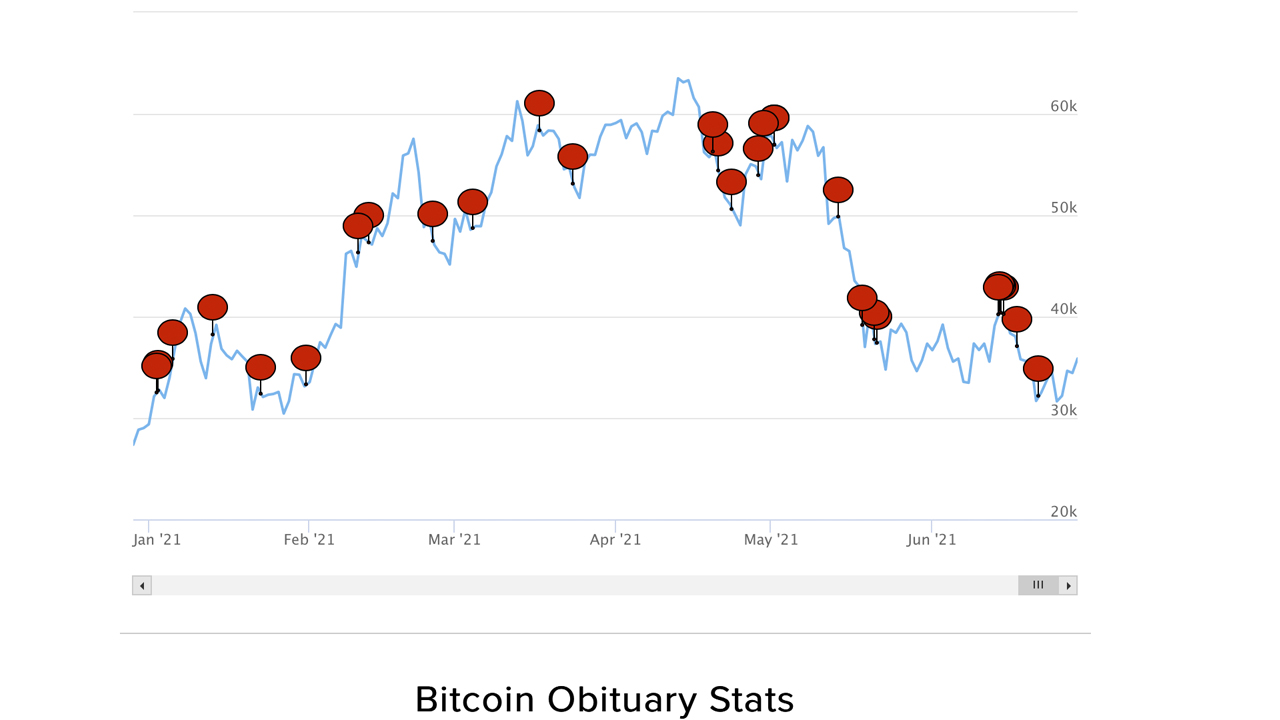
Bitcoin obituaries have doubled in 2021, in comparison to last year, which indicates that critics are more willing to pounce on the crypto asset’s market slides. There were 14 bitcoin deaths recorded by 99bitcoins.com in 2020 and today there are 29 deaths for 2021.

As of today, there are roughly six months left until 2022, and this year’s BTC deaths record may compete with years like 2019 (41) and 2015 (39). It will take a lot of deaths for bitcoin to catch up to the record high in 2017 when 99bitcoins.com recorded 124 deaths.

There Are Now Twice as Many 2021 'Bitcoin Deaths' Compared to 2020's BTC Obituaries List
2021 bitcoin obituaries chart on June 30, 2021. Bitcoin died 29 times this year so far, while bitcoin died 14 times in 2020. Since 2010 up until the last day of June, bitcoin has died 422 times, according to 99bitcoins.com stats.

The very first bitcoin obituary was recorded on December 15, 2010, and the author’s decade-old eulogy was called “Why Bitcoin can’t be a currency.” Fast forward to today and bitcoin died just recently on June 21, when the renowned author Nassim Nicholas Taleb wrote a summary of bitcoin’s failures called “BTC Is Worth Exactly Zero.”

“In its current version, in spite of the hype, bitcoin failed to satisfy the notion of ‘currency without government’ (it proved to not even be a currency at all), can be neither a short or long term store of value (its expected value is no higher than 0),” Taleb said.

“[Bitcoin] cannot operate as a reliable inflation hedge, and, worst of all, does not constitute, not even remotely, safe haven for one’s investments, shield against government tyranny, or tail protection vehicle for catastrophic episodes,” the “Black Swan” novelist further stressed.

On Youtube, economist Maurice Hoefgen gives the bitcoin obituaries web portal its next death that precedes Taleb’s scathing review. Hoefgen in his interview with DW News on June 17, says bitcoin doesn’t have good characteristics of money. The economist wholeheartedly believes that “Over the long term bitcoin will fail.”

The 27 other 2021 bitcoin obituaries all have similar reasons as to why BTC is resting in its casket and prepping for a funeral service. Reasons such as volatility, scarcity, speculation, hype, criminal use, government crackdowns, and environmental arguments are the main talking points in these eulogies.

Economist Paul Krugman and Author JP Koning Don’t Think Bitcoin Is Dead but Now Consider It a ‘Natural Ponzi Scheme’

Many bitcoiners would say that it’s safe to say that bitcoin is not dead. However, it’s guaranteed to be doubted and considered a complete failure along the way by pessimists who don’t understand Satoshi’s creation.

Even the fax machine-loving Nobel laureate and economist, Paul Krugman, took a crack at the crypto asset this week. Krugman didn’t say BTC was dead but referred to JP Koning’s critique and called it a natural Ponzi scheme.

“Nice essay via Ftalphaville,” Krugman said. “Bitcoin has clearly failed in its mission to become money, but its value is sustained because it has become a sort of natural Ponzi scheme.” However, not everyone appreciated Krugman’s borrowed assessment from Koning’s essay.

“Honest question: is there any example of a Ponzi scheme which had a second major rally to new ATH’s after the first growth phase collapsed?” Shapeshift founder Erik Voorhees asked in response to Krugman’s tweet.

What do you think about the quantity of bitcoin obituaries doubling in 2021? What do you think about the statements from Paul Krugman? Let us know what you think about these subjects in the comments section below.

Moonbeam’s interoperability and compatibility will drive the next wave of application development and user growth


The Cryptocurrency Whale Phenomenon: How do Investors thread Volatility Splashes?


Cryptocurrencies remain extremely volatile. Bitcoin is consistently on track for topping their biggest monthly increase and decline. It faced one of their record-highs of 37.5% decline just this May 2021, and frequently sees drops like 37% drop seen in November 2018 and 40% slide in September 2011. Most recently, the price of bitcoin climbed to $34,805.19 Monday 28th June 2021, up 8% from where it stood at 5 p.m. ET Friday, after Mexican billionaire Ricardo Salinas Pliego encouraged its purchase. This volatility serves as a double-edged sword, both as an exciting asset choice for some investors and apprehension for others, preventing widespread adoption.

One contributing factor to volatility is that the crypto markets have an abundance of whales – a term given to someone who holds a significant amount of a particular asset; someone who holds a minimum of 1,000 Bitcoin is considered to be a whale. The sheer size of their holdings means that, when they decide to sell, the market is suddenly flooded with this asset, causing big price movements.

These powerful investors exist across all asset classes, but cryptocurrencies are particularly vulnerable because there are more whales, but much smaller volumes and less liquidity across a fragmented sea of exchanges. Without sufficient liquidity, these whales are trapped in a proverbial swimming pool, destined to send huge waves through the market as soon as they move. Because each exchange is segregated into their small swimming pools of liquidity, they are incredibly susceptible to whale movements.

For that reason, we need to solve the liquidity problem by joining all these segregated small swimming pools into one big ocean. The trading technology of the crypto market has not yet caught up to the maturity and stability of forex, which employs OTC trading, which is how it minimizes the effects of large buy and sell orders that can drastically move the market. If the crypto market integrates that, this can dramatically improve crypto exchange liquidity and stabilise pricing as a result. It’s time to deepen the liquidity pool.

The influence of whales

Cryptocurrency assets are still fundamentally very concentrated. The sudden growth of Bitcoin means that a large portion of the market is owned by a small majority of traders who were fortunate enough to buy lots of Bitcoin when the price was low. Currently, around 40% of Bitcoin is held in around 2,500 accounts.

The same is true of altcoins. For example, it was revealed in February this year that one person holds 28% of Dogecoin, which has soared by almost 1,400% since the start of the year. An individual in possession of that large a proportion of the market has a huge effect on the price.

And the effects of these whales are visible. When whales are selling, the prices of cryptocurrencies are on a downward spiral. On April 18th, for example, one trader moved 58,814 BTC – worth more than $3.3 billion at the time – from Binance to a private wallet at the same time as the prices slid to a low of $51,541 per unit.

While whales are clearly affecting the price of Bitcoin, their influence is greater among altcoins, which have lower market caps and are less liquid. Not long ago, the price of Ethereum plummeted by more than 50% on the Kraken Exchange, plunging from $1,628 to $700 within the space of minutes.

The CEO of Kraken attributed this to single sell, saying “it could be that a single whale just decided to dump his life savings.” For Ethereum to drop $1000 dollars in three minutes is extraordinary and it proves that even the biggest exchanges with large volumes can be rocked by big whale movements.

Shrinking liquidity

Considering price swings are compounded by fragmented liquidity, the market must pay attention to the fact that liquidity is getting worse, not better. The amount of Bitcoin on exchanges is down 20% over the last 12 months. Slowly but surely, liquidity is drying up and the pool is getting smaller.

The bullish cryptocurrency market means people are holding the asset, simply watching the price tick up. Evidence suggests that there is a growing number of whales, with the number of individual holders of over 1,000 Bitcoin at an all-time high of 2,334. So, despite growing popularity, there is still only a very limited amount and diminishing amount of cryptos changing hands.

Contributing to these problems, big investors are entering the crypto market in swathes. Institutional investors, hedge funds, high-net worth individuals, and companies – most famously Tesla – are all looking to hold and trade crypto assets. And with more buying power, it is likely to increase order sizes and add to the influence of whales.

We cannot prevent these big players from influencing crypto trading, but solutions for the underlying lack of liquidity that exacerbates price swings exists.

Unifying the pool

To combat whale-induced price swings, the market is slowly adopting tactics from other asset classes. For example, many OTC brokers are targeting crypto whales to trade digital currencies over the counter because they can access more liquidity than exchanges.

However, for a lasting solution that can cushion large orders and prevent sudden and drastic price changes, exchanges should turn to trading technology that has been mastered in other markets. For example, the FX markets have long provided Straight-Through-Processing capabilities on a global liquidity network, where orders are aggregated and processed using Smart Order Routing. This infrastructure allows global price discovery, where the best bid and ask prices are presented to all market participants, regardless of trading avenue.

Effectively, it allows exchanges to leverage the liquidity of other exchanges, including from the biggest in the industry. Using this model, exchanges can consistently provide traders the best prices and absorb the impact of big whale splashes by drawing on liquidity from the wider market. The multiple individual pools join to become an ocean.

Only once these issues are addressed will cryptocurrencies be free of the volatility that comes with so many big fish in a market lacking depth.