Powered By Blogger

Thursday, 1 July 2021

How to Mine Bitcoin At Home And Make MoneyDetailed and Easy Step to Step Guide With Cost And Income Analyses


The term cryptocurrency is getting a lot of spotlight since the last few years or maybe an entire decade. The world eyes its ups and downs, and it has become the ultimate obsession. With the ever-growing interest in the subject, people have started exploring multiple avenues to become a part of this digital revolution.

Mining allows people to get a grip over cryptocurrencies like Bitcoin withouactually buying them. However, mining is one of the most volatile aspects of the crypto-world; and it comes with its own unique set of hardships.

Remember, it’s not you it’s the system doing the hard work. Your job is to take care of the hardware, and you are the Watson to this Sherlock.

It’s OK not to understand it; most of us don’t understand paper money, although it has been around since eternity, yet we use it despite the lack of knowledge.

What is a Bitcoin?

Bitcoin is a decentralized network of digital currency where the transactions are made to and from a 16 character encrypted address is (it’s like a social security number of the crypto world). These addresses are mathematically secured so that nobody but the address owner can transfer the funds that belong to it ( the two-factor verification).

In simple words, bitcoin is a network of independent computers that generate, propagate and verify monitory transactions.

How Do you buy bitcoin?

  1. Before you can buy bitcoin, you have to install wallet software onto your computer. The wallet will allow you to send and receive and transfer bitcoin.
  2. To purchase bitcoin, you have to deposit money into an online exchange that connects bitcoin buyers and sellers.
  3. Once the exchange has accepted your currency, you can place an order for bitcoin, similar to how you would buy a stock.

How does bitcoin works?

It is a worldwide, decentralized peer-to-peer network

  1. Mines develop bitcoin by using computers to solve mathematical functions, and further, the same process verifies the transactions.
  2. Then the Bitcoin exchange trade is made using conventional currencies (dollars and pounds ). It offers a gateway into all the action happening in the world of cryptocurrency for non-miners. (it’s almost like buying stocks via a trading application)
  3. Individuals and businesses create wallets that allow them to send and receive bitcoins. ( it is similar to having a PayPal account or even stripe ). In contrast, Cryptography secures the network and ensure that all balances and transactions are safe.

Want to mine Bitcoins at home?

Here’s a step-by-step guide

First up, what happens in cryptocurrency mining?

Cryptocurrency mining is the method of corroborating crypto transactions and adding them into a blockchain ledger.

In order to successfully mine or authorize a cryptocurrency transaction, one has to compete with other miners and perform complex calculations on blocks containing transaction data — which requires enormous processing power.

However, once the work is done, you get rewarded with a certain quantity of Bitcoin or whatever currency you are mining.

Can I mine bitcoins from my laptop?

The one-word answer is yes, but are you going to make any decent money? No. Mining bitcoin is definitely is an option, but you will end up making pennies.

Basically, a computer’s processing power and speed defines hash rate or mining speed that directly impacts your profits.

Mining Bitcoins at home:

Things to remember —

If you want to earn a substantial amount of money mining bitcoin, you need heavy processes. If it could have been done at your home PC, why would people build bitcoin mining farms? Although most bitcoin farms are set up in colder areas to delay the overheating of machinery, which is inevitable. Hence, if your computer is not well-equipped with a powerful processor and GPU, the mining would be very slow, and you will not generate ample Bitcoins to justify this charade.

The crux is that the process will take a toll on your machinery, and hence the quality of machinery will directly determine the money you make.

The mining checklist

In today’s time, the best way to start mining is by building up an ASIC, i.e. application-specific integrated circuits, as these days, mining by laptops is not profitable.

Now you must be having a million questions in your head that “where can I buy the hardware?”, “what about the energy consumption?” and “how do I get started?”

Here are some answers:

  • Most of the Bitcoin miners don’t consider the location for setting up the mining rig as an efficient setup can take a garage space. Hence check out the options before taking a plunge.
  • Look into your areas electricity supply, voltage And enquiry about the power rates per kilowatts. Most of the big mining farms are located in places like China, Russia, and the countryside of Europe, where electricity is both cheap and readily available.
  • Each Bitcoin ASIC miner requires its own 220v outlet, conduct a survey at the place of installation, and pre solve these issues according to however many mining rigs you want to build. Remember not to overload the circuit.
  • Another significant issue with setting up a massive mining rig is the immense amount of heat produced. In winters, it’s going to act like a prepaid heater, but you’ll be boiling through the summers, although heat is not a problem with small setups.
  • Although high-speed internet is not a problem for most of us, yet consider looking into it beforehand.

You don’t have to be Charles baggage to do this. Just put on your miner hat and follow these five simple steps.

The five-step strategy:

Step 1

Build a bitcoin mining rig

What is a crypto mining rig?

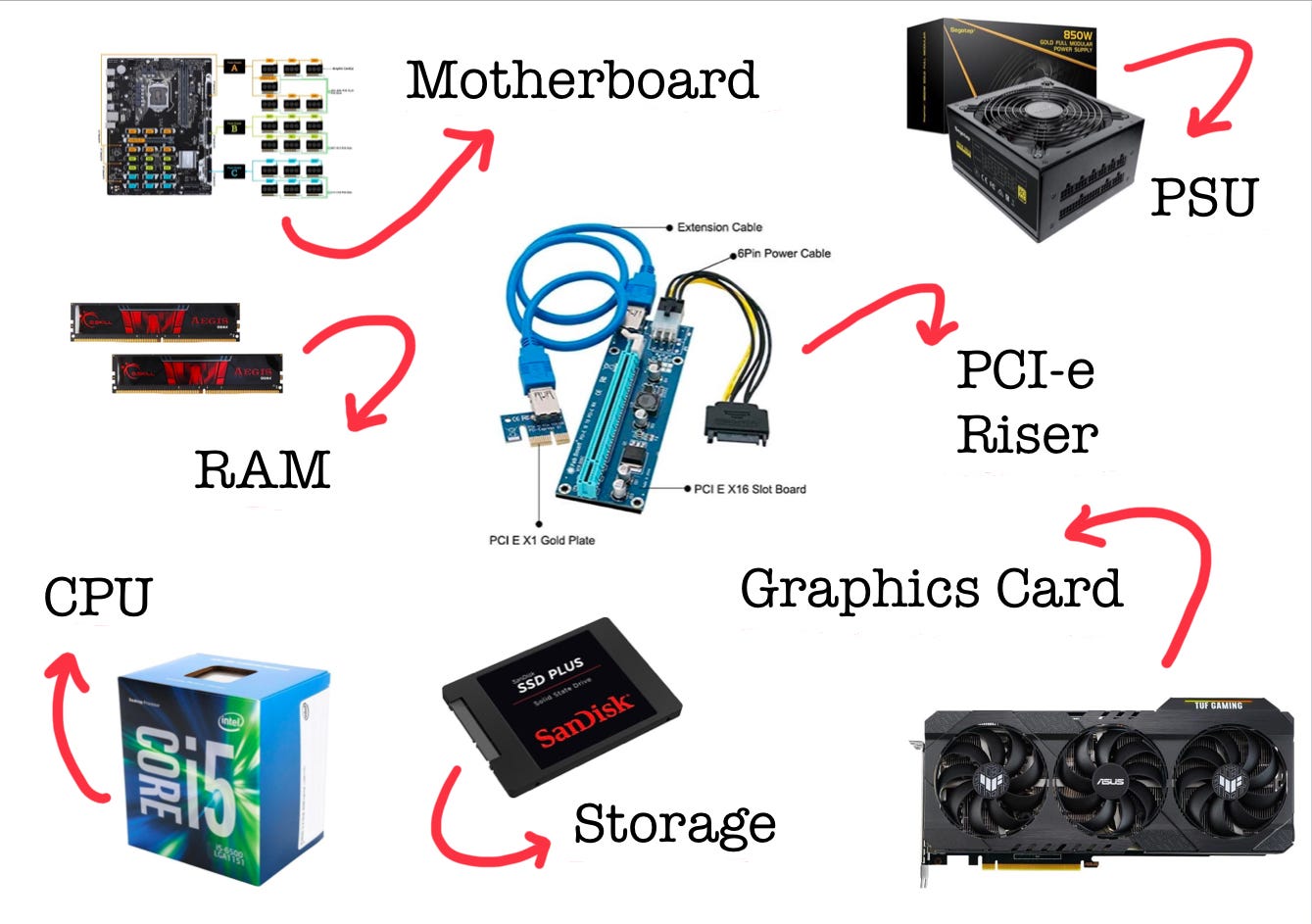
The “rig” is nothing but a customized computer. A rig has all the common PC elements, such as a motherboard, CPU, storage, and RAM. Things diverge from the benchmark of personal computers when it comes to graphics cards.

While mining cryptocurrency, the graphics processing unit does all the hard work and not the Central processing unit.

You’re going to need reasonably a powerful GPU for mining, and you will likely be buying more than one — a lot more than one. A mining rig can consist of a relatively affordable PC with powerful GPUs.

You will need to connect multiple graphics cards to one system. You’ll also be required to add more than one PSU ( power supply unit )and a high performing motherboard if you’re planning to push things to the extremes.

You can also attach an ASIC to the computer and upgrade its processing power, further adding to the cost.

It’s a game of trial and error. Be patient; it will all work out fine.

Components of a mining rig:

Required hardware and costs:

Motherboard: $450

Monitor: $120

CPU: $125

RAM: $65

Storage: $95

PSU: $100

PCI-e Riser: $60

Graphics Card: $500 - $1500 ( this is where you go wild)

Total cost of set up = $1,515 ( minimum )

*Whereas you can take it as high as you want to.

Step 2

Pick a digital wallet

Once you’ve organized the acceptable hardware and created a rig. (either through ASIC or GPU ), you’d need to put up a digital wallet to store Bitcoin rewards. They allow you to manage your Bitcoin addresses, whereas each bitcoin address has two keys; one is private, and the other is public. Remember that if you lose the private key, there is no way to recoup those Bitcoins. To receive payments, you convey your public key, and it acts like your bank account number.

There are numerous Bitcoin walkers, and you can pick one like Coinbase, Ledger or SoFi.

Step 3

Pick a mining pool

It has become hard even for the best individual rigs to compete with these gigantic mining farms in today’s time, and hence you need to pick a mining pool. So think of this as a complex school project where you have created small groups to solve the case.
This will fortify your chances of making a profit, but remember that the rewards earned through pooling would be distributed among all the members who contributed to the joint endeavour.
Some common mining pools are slush pool, BATPOOL, 1Hash and the largest one being AntPool.

Step 4

Get a mining programme for your computer

Hardware ✅

Bitcoin wallet ✅

Mining pool ✅

Now it’d time to Install a legit Bitcoin mining software on your systems, such as EasyMine, GUIMiner or CGMiner.

The mining software connects you with the clients and actual Bitcoin and blockchain network. It’s the software’s job to receive Bitcoin orders, collect the completed results ( proof of work ), and add all this information to the blockchain network. The mining software also accesses the mining activities and shows statistics like hash rate, temperature, cooling, and average mining speed.

Step 5

Start mining

And once you have installed the software, you can start mining and earning Bitcoins. Once you start the cycle, the mining software will communicate with the pool servers to band your machine’s mining effort with others on the pool.

Let the machine do its magic.

Come on, kids, it’s time for revision

  • Set up the rig ( hardware )
  • Connect the power
  • Create a wallet
  • Join a mining pool
  • Install the mining software
  • Put in your information about your wallet and mining pool into the mining software, and start mining.

The cost and profit analysis:

Mining on laptop:

With today’s insane prices of bitcoins, you’ll be making 1/100,000th of BTC. Taking about tens or maybe a hundred years to mine one BTC.

Mining via rig:

A mining rig consisting of 1 GPU costing $1,500 would generate 0.00021888 BTC bringing a per day total at $10-$12 per day, i.e. $300-$360 per month.

In today’s time, the increase in demand for GPUs has made it challenging to meet the supply, and hence some people end up buying these high processing GPUs in pre-used or black markets.

But with an early investment of $15,000–$20,000, you can make (excluding the expenses of electricity) -

$135-$140 per day

You can pay off the initial $15,000 in 111 days, bringing your total monthly profits to $4,050.

Bonus:

For a profitable mining venture, you must keep your eyes and ear open. You need to be updated with current events of the cryptocurrency universe and have a vision of what you are doing. The crypto market changes rapidly, something at the rate of miles per second, so polish those reflexes and brain processing power.

Edward Snowden’s Shocking Revelations on Bitcoin Are Everything


Edward Snowden, who catapulted to fame in 2013 as the whistleblower by uncovering the National Security Agency’s (NSA) massive surveillance program, has had a bittersweet relationship with Blockchain. Snowden was employed as a computer intelligence analyst in the global communications division at the CIA (Central Intelligence Agency)headquarters in Langley, Virginia. Since his explosive exposes, he has been granted political asylum in Russia.

Snowden enjoys a massive following and participates in public debates by appearing in the news, and through his social media handles, he makes it a point to put across his thoughts on various diverse issues.

His recent comment on the Biden administration’s 6 trillion dollar stimulus plan in which he termed it as “good for bitcoin”, has garnered immense interest amongst the cryptocurrency enthusiasts. Of course, this is just one of the many instances where Snowden has spoken about bitcoin.

It would be best if you were an even bigger crook to con the faceless shark with everything helping his purpose.

Let’s analyse his statements on bitcoin and cryptocurrencies in general over the years:

Bitcoin holders, you are under surveillance !!

Edward Snowden has always been a fierce critique of government surveillance. According to him, the government’s around the globe are employing highly sophisticated surveillance and monitoring systems to sort through the massive public ledgers.

Bitcoin’s public ledger is nothing less than a jackpot for such governments, and that is why they often leave no stone unturned and use state of the art monitoring techniques to keep an eye on it.

To counter such intrusion into privacy, the most logical next innovation would be the evolution of private blockchain cryptocurrencies like zcash, which offer privacy by default.

So basically, if such private blockchains aren’t the norm in a couple of years, it will not be so because of lack of innovation or inability of technology; rather, it will be due to the excessive regulation and stringent surveillance systems of government.

Cryptocurrencies are here to stay, but not Bitcoin

Snowden sees critical flaws in bitcoin’s design, such as its transparency, security, transaction rate, and speculative tendencies. But Bitcoin’s biggest structural weakness, as flagged by Snowden, is its public ledger, and if this is not addressed, it will lead to fading out of bitcoin in the long term. That is because Snowden gives primacy to privacy over everything else. A public ledger is a record of every transaction in Bitcoin that is readily available to everyone.

The existing mechanism of the bitcoin blockchain is marred with balancing the recording of every transaction and simultaneously scaling its capacity to process these transactions. This balancing mechanism is incompatible with the idea of having an enduring and sustainable ecosystem for trade because it is not feasible to have a lifelong history of everyone’s purchases, make these interactions available to everyone and have that work out well at scale too.

WHAT IS BITCOIN’S WORTH?

Bitcoin’s inherent design permits the mining of new coin in a predetermined and at natural accelerating speed. Further, there is a cap of 21 million coins. Over half have already been mined, which nudges us to ponder that bitcoin will soon become a fixed money supply with absolutely zero scopes for further growth or expansion. In an interview, Snowden points out that there is a minuscule difference between fiat money and cryptocurrencies apart from the fact that the fiat currencies derive their backing from the state.

By comparison, Bitcoin’s value is pegged to the finite supply of 21 million and its acceptance amongst people worldwide. Therefore it can be safely inferred that bitcoin has a minimal fundamental and intrinsic value but has a highly variable speculative value based on genuine scarcity.

Bitcoin is slow

Bitcoin’s throughput is severely constrained by factors such as the size of blocks and on-chain scaling. Snowden claims that bitcoin’s transaction channel can handle only around seven transactions per second. In contrast, payment gateways like Visa and MasterCard routinely process tens and thousands of transactions per second.

This, according to Snowden view, has been a significant drawback and limitation present within the bitcoin network. Hence, to be valid for everyday transactions and decrease the associated costs of bitcoin’s Blockchain, there is an urgent need to fix the glitches with bitcoin’s lightning network (LN) and increase its throughput to a much higher level.

For bitcoin to survive in the long run, there is an immediate need to address these critical issues and ensure that the users do not have to spend hours waiting for their transaction to go through and shelving out around 20USD as transaction fees every time the network gets congested.

Bitcoin is not compatible with the fundamental right to privacy

Snowden’s complaint with Bitcoin revolves centrally around the fact that transactions done via Bitcoin are not private as the ledger is readily available to everyone. He vehemently argues that it should be private by design. He believes that an open ledger is very harmful and fundamental negates the idea and concept of private money that can be spent freely.

The Public ledger compulsorily makes the ledger of businesses open to all, including their competitors, which may ultimately lead to losing leverage.
Combined with the issue of digital surveillance and the rise of authoritarian regimes across the globe, Bitcoin seems to be failing comprehensively on the privacy angle as it is very vulnerable to correlation attacks that can dish out various personal details about a user. In extreme cases, it can reveal identities when user history is accessed through highly sophisticated surveillance systems.

Further, he calls out the CIA to develop a tool that renders coin mixing operations outmoded by running a host of analyses on the public ledger. This aggressively stresses to the fact that individual Bitcoins could have a “dirty” history attached to them, making them less fungible.

Takeaway

  • To sum up, it boils down to when the cryptocurrencies like bitcoin will design competing systems and mechanisms to tackle the challenge of threat to privacy by powerful agencies, governments, and authoritarian regimes that boast powerful surveillance techniques.
  • Sooner or later, the dictators, powerful entities, corrupt and resourceful persons will encroach on these emerging technologies and outlaw them.
  • The only sustainable way out is to design competing systems that tackle all the shortcomings of the present systems and at the same time attract the global consumer base. Until then, the only form of money which trumps all when it comes to privacy is CASH.

In the end, If anything is too good to be true, it probably is. And you must keep your greed in check and make calculated moves to make money out of the cryptocurrency circus.


US Congressman Calls for Law Allowing Government to Reverse Cryptocurrency Transactions


A U.S. congressman has called for a law that allows the government to identify cryptocurrency users and reverse crypto transactions. “There’s a significant sentiment, increasing sentiment, in Congress that if you’re participating in an anonymous crypto transaction that you’re a de-facto participant in a criminal conspiracy,” he said.

Rep. Bill Foster Stresses the Need for Law to Allow the Government to Reverse Crypto Transactions

Democratic Rep. Bill Foster of Illinois, who is also co-chair of the Congressional Blockchain Caucus, talked about cryptocurrency regulation during an Axios virtual event Tuesday. Addressing the problem of ransomware attacks and how criminals are asking for bitcoin and not cash, the congressman stressed that “there is a fundamental difference between crypto assets and real-world assets. That’s an important distinction that we must make ultimately in the law.”

Emphasizing that laws must be passed to allow federal courts to identify crypto users and reverse transactions in bitcoin or other cryptocurrencies, he said:

You have to be able to go to a court to unmask participants under some circumstances.

He discussed “The condition under which we can reclaim” cryptocurrencies, such as ransoms paid to criminals, noting that it is one of the fundamental decisions which has to be made about crypto assets.

The congressman pointed out that the law needs to address whether cryptocurrency is “truly anonymous or is there a court you can go to, to unmask the participants.” In addition, “is there a court, a third-party, that you can go to, to reverse fraudulent or mistaken transactions.”

Foster gave an example. “If someone dragged you into an alley and put a gun to your head and say get out your cell phone and transfer all your bitcoin to my wallet. Are you just out of luck or can you go to court, have them unmask the participant.” Furthermore, “can the court — if they decide that the transaction was fraudulent, criminal, or mistaken … use its access to very heavily guarded key, cryptographic back door, in a sense, that allows them to cryptographically reverse transactions on a blockchain.”

The lawmaker claims that such tools are necessary for the government to protect itself, the people and companies from ransomware attacks, like the one suffered by Colonial Pipeline.

Rep. Foster opined:

I’ve just said about three things there that will drive the crypto purists berserk, like the trusted third party and so on.

He believes that “For most people, if they are going to have a big part of their net worth tied up in crypto assets, they are going to want to have that security blanket of a trusted third-party that can solve the problem when they get hacked, when they get stolen or even just a mistaken assumption.”

Foster further said that cryptocurrencies must become compliant with federal regulations and laws for them to ever become mainstream instruments for conducting transactions. Replying to a question about how the U.S. would regulate cryptocurrencies given their global and borderless nature, he affirmed, “We’re going to have to establish a law between the legal and illegal regimes here,” elaborating:

There’s a significant sentiment, increasing sentiment, in Congress that if you’re participating in an anonymous crypto transaction that you’re a de-facto participant in a criminal conspiracy.

Many people took to social media to ridicule the congressman and his attempt to reverse bitcoin transactions, stating that he does not understand how bitcoin works. Some responded to Foster’s criminal allegation, stating that they are “not de-facto criminals.”

What do you think about Rep. Foster calling for legislation to give the government power to reverse cryptocurrency transactions? Let us know in the comments section below.

Coinbase to Launch Apple-Like Crypto App Store


Cryptocurrency exchange Coinbase has unveiled its plan to build “the crypto app store,” inspired by how Apple Inc. built its app store. CEO Brian Armstrong said: “Apple didn’t attempt to build every app for the iPhone, it empowered developers and gave mobile users an easy way to access new innovative apps.”

  • In a blog post published on Tuesday, Coinbase CEO Brian Armstrong detailed several opportunities in the crypto space the Nasdaq-listed company is pursuing. One of them was to “Build the crypto app store.”
  • The CEO detailed, “Like the internet, or the mobile app stores, we’re seeing developers rush into the space to use these new tools to develop innovative use cases that we couldn’t have imagined before,” adding:

Apple didn’t attempt to build every app for the iPhone, it empowered developers and gave mobile users an easy way to access new innovative apps … We’ll work to give our users easy access to all of this from the main Coinbase product.

  • Armstrong stressed: “We need to do the same [as Apple] in crypto. There is now 10s of billions of dollars of economic activity running on Dapps, and a new trend coming out every three months.”
  • He further shared:

Soon any app built on decentralized crypto rails will be accessible to users of the Coinbase app … In the future you will have the option to do self-custody of your crypto, right in the main Coinbase app.

What do you think about Coinbase launching an Apple-like app store? Let us know in the comments section below.

Triall: Bridging the Gap Between Medical Research and Blockchain Technology


The COVID-19 pandemic has ravaged the global economy, leaving many industries re-evaluating the robustness of legacy models in times of crisis. Unsurprisingly, one of the most impacted industries has been the global healthcare industry, as governments raced to test for, treat and develop a vaccine for the fast-spreading virus. Whilst, on the whole, the testing regimes, treatments and vaccination programs have been somewhat successful in developed countries (especially the United Kingdom and Israel), existing pain points in pharmaceutical research and development have exacerbated delays according to a number of experts.

Namely, the clinical trial industry, a sector responsible for testing the safety and efficacy of new vaccines and therapeutics before these enter the market, is currently hampered by various inefficiencies. The pandemic has exemplified the need for solutions to tackle these inefficiencies and thereby help ensure an efficient influx of new medicines.

This is where Triall enters the scene.

Triall is building a global digital ecosystem for clinical trials. Capitalizing on both the rapid digitalization of healthcare and the technological advances in the blockchain and crypto space, Triall is applying blockchain-based technologies to a sector that has become increasingly complex, data-heavy and fragmented over the past decade.

Increasing Costs and Longer Development Timelines

Clinical trials are integral to the healthcare industry’s response to new and existing diseases and viruses. They involve a number of industry stakeholders, including pharmaceutical companies, contract research organizations, and hospitals, as well as external parties such as governments and regulators.The clinical trial industry plays a crucial role in ensuring that society’s unmet medical needs can be addressed, inside and outside of crisis situations like the COVID-19 pandemic.

However, the clinical trial process is currently fraught with complexity and resource-inefficiency which artificially lengthens development timelines. There are several notable reasons for this, including:

  • Fragmentation: Data is scattered across sites and systems.
  • Oversight issues: Clinical trial professionals experience a lack of oversight over their clinical trial processes and activities.
  • Inefficient record-keeping: There is no efficient and universal way to manage and store data, causing significant delays and safety risks, as well as increasing costs.
  • Data integrity issues: There are a growing number of data integrity issues being uncovered during clinical trial inspections according to the World Health Organization (WHO).
  • Low patient engagement: As much as 85% of trials fail to retain enough patients which also leads to costly delays.

Indeed, the data show that these problems are only getting worse, with the cost of clinical trials increasing up to 9% per year on average. More shockingly, the sector suffers from a development success rate of just 11%.

Upgrading Global Healthcare with Technology

Triall’s innovative new platform is laser-focussed on resolving these critical issues and shortening the time to market of new medicines. The company is building a global ecosystem for clinical research professionals that crosses organizational boundaries and domains. Participants in the platform include: clinical research professionals, medical staff, patients and software developers, as well as other contributors and maintainers such as blockchain engineers and node operators.

Fundamentally, the platform allows for the efficient exchange of clinical trial data leveraging blockchain-enabled technologies and open standards for identity and access management. Triall will implement Decentralized Identifiers (DIDs) and Verifiable Credentials (VCs) to integrate the severely fragmented landscape of industry stakeholders in the clinical trial sector. As a result, Triall’s platform will ensure clinical trials can be conducted smarter, safer and more-efficient due to more closely integrated workflows.

Speaking about Triall’s driving philosophy, the company’s CEO, Hadil Es-Sbai had this to say:

“We believe state-of-the-art Information Technology and scientific insights make a difference. Our passion lies in advancing clinical development, consolidating the unconnected, and fostering a global ecosystem that promotes trust and reliability throughout all phases of clinical development.”

The Future of Clinical Trials

Combining this driving philosophy with the rapid digitization trends resulting from the pandemic, Triall is positioned to take a leading role in revolutionizing the clinical trial space.

In addition to its unique approach, Triall also leverages a breadth of experience in the field. The Triall team has managed over 100 clinical trials in more than 30 countries. Accordingly, the company has curated a strong and global network of stakeholders that will be instrumental to driving its platform’s development. Moreover, with 250+ peer reviewed papers published in various top-tier scientific journals, Triall also brings a wealth of academic knowledge, combining academic experts from several medical disciplines that support the shaping of its platform’s features. These include experts on topics such as immunology, infectious diseases, vaccinology, microbiology, eHealth technologies, drug and vaccine development.

Finally, Triall is already more than just a proof of concept. Its first application Verial eTMF, a blockchain-integrated document solution, was piloted in the summer of 2019. According to the team, this was the world’s first implementation of blockchain in a live and running clinical trials. The commercial version of Verial eTMF is now being onboarded in 6 clinical trial projects around the world. Indeed, this serves as the ultimate mark of validation, from both the market and industry.

For more info on how Triall is bridging the gap between the healthcare and crypto domains, visit their website here