A growing number of crypto firms in the U.K. are withdrawing their applications to register with the Financial Conduct Authority (FCA). Around 64 firms have already withdrawn their applications and will not be able to operate in the U.K.
The list of cryptocurrency companies abandoning their attempts to register with the U.K.’s financial regulator is growing, Reuters reported Monday.
Under the current crypto regulation, the Financial Conduct Authority (FCA) is responsible for ensuring crypto companies’ compliance with laws on the prevention of money laundering and terrorist financing.
Companies wanting to provide crypto-related services in the U.K. must register with the FCA before conducting business.
An FCA spokesperson said Monday that registration data shows the number of companies that have ditched their applications jumped by 25% in less than a month.
Around 64 companies have withdrawn their applications, the spokesperson said, up from 51 in early June.
Only six firms have successfully registered with the FCA so far, the publication conveyed, adding that dozens more companies are being assessed but they are not yet deemed “fit and proper.”
The FCA issued a consumer notice on Binance Friday, banning the exchange from engaging in “regulated activities” in the U.K.
What do you think about crypto firms exiting the U.K. due to regulation? Let us know in the comments section below.
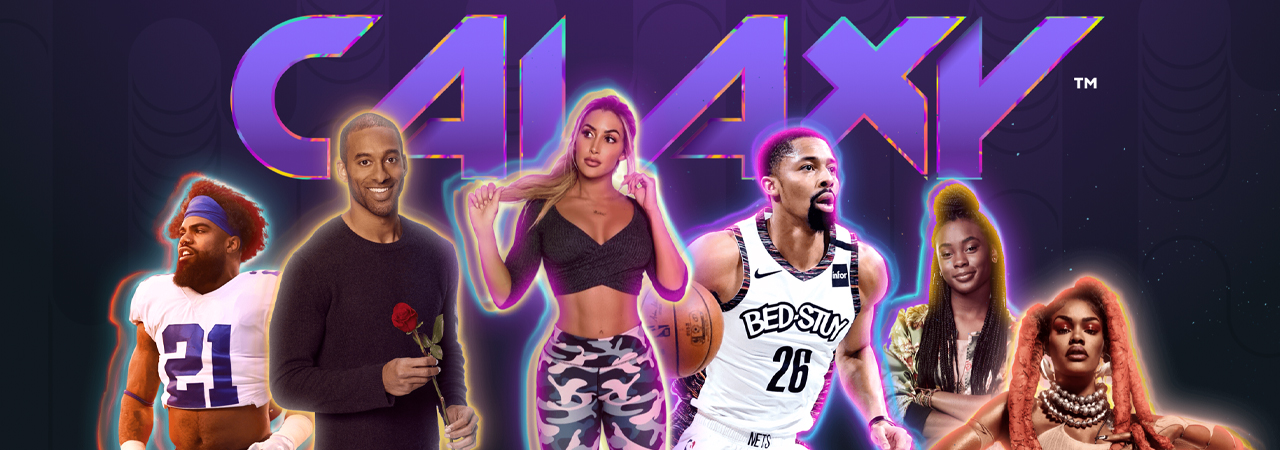
According to an announcement revealed on Thursday, Spencer Dinwiddie’s token application called Calaxy has raised $7.5 million in funding. The American professional basketball player for the NBA’s Brooklyn Nets has been a fan of blockchain technology for quite some time, as the point guard raised $1.3 million tokenizing his contract on the Ethereum blockchain.
Hedera Hashgraph-Powered Calaxy Raises $7.5 Million
The NBA star Spencer Dinwiddie’s token application Calaxy raised $7.5 million in funding according to statements sent to Bitcoin.com News. The capital raise announced this week stemmed from a deal that involved the acquisition of future CLXY tokens.
Spencer Dinwiddie’s Calaxy App aims to be the “first social media super app designed for creators, by creators.” The financier Solo Ceesay is Calaxy’s COO and cofounder who said he saw an opportunity in creating a platform that helps monetize an online community.
Calaxy leverages the enterprise-grade blockchain network Hedera Hashgraph, a project backed by firms like IBM and Google. The Calaxy platform will leverage a native token called “CLXY.”
Calaxy aims to offer interactive polls, messaging, video calls, and the ability for fans to engage with influencers like sports stars and musicians. The name Calaxy is a play on the words “creator” and “galaxy.”
At the time of writing, Calaxy is in private beta and the first public version of the application will be ready in the near future. The app will be available on Google Play and Apple’s App Store and people can sign up to request early access to the public beta to get a key.
Spencer Dinwiddie had a token sale of his contract hosted on the Ethereum blockchain last year. The sale of Dinwiddie’s tokenized contract raised $1.3 million which was only a tenth of what the project hoped to sell ($13.5 million).
Dinwiddie’s NBA contract was tokenized by leveraging Dream Fan Shares (DFS), however, the NBA star is leveraging Hedera Hashgraph over Ethereum because it boasts a higher transaction throughput.
The point guard for the Brooklyn Nets initially told the press he would tokenize his contract in 2019 but the NBA threatened to end his contract. Despite this, Dinwiddie continued his mission and has been a proponent of blockchain technology ever since.
What do you think about Spencer Dinwiddie’s and Solo Ceesay’s Calaxy social media application raising $7.5 million in funding? Let us know what you think about this subject in the comments section below.
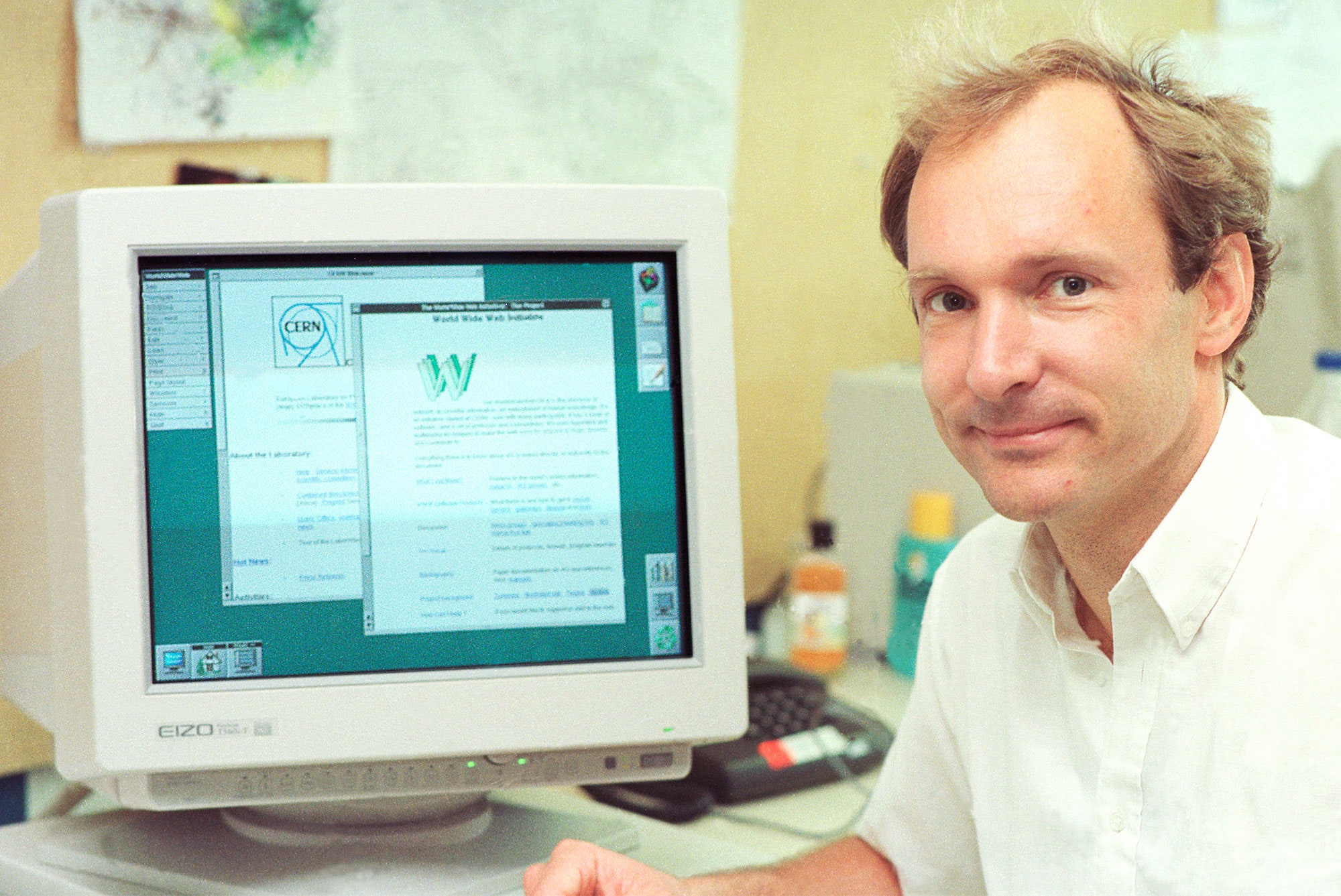
Sir Timothy John Berners-Lee, the English computer scientist who is well known for inventing the world wide web has sold a non-fungible token (NFT) in an online auction hosted by the auction house Sotheby’s. The NFT is basically a video of the World Wide Web’s source code created in Python and the collectible sold for $5.4 million.
Tim Berners-Lee and Sotheby’s Auction NFT for $5.4 Million
This week, Sotheby’s revealed that Tim Berners-Lee sold an NFT of the original source code for the world wide web for a whopping $5.4 million. Before the NFT auction, Berners-Lee told the publication the Guardian: “I’m not selling the web – you won’t have to start paying money to follow links. I’m not even selling the source code. I’m selling a picture that I made, with a Python program that I wrote myself, of what the source code would look like if it was stuck on the wall and signed by me.”
Sir Timothy John Berners-Lee, the English computer scientist who invented the world wide web.
Berners-Lee invented the web in 1989 and before the NFT sale he said “The core codes and protocols on the web are royalty-free, just as they always have been.” A representative from Sotheby’s said the non-fungible token collectible art auction was historical and the fact that Berners-Lee verified the NFT makes it even more valuable.
“The symbolism, the history, the fact that they’re coming from the creator is what makes them valuable, and there are lots of people who collect things for exactly those reasons,” Cassandra Hatton, the global head of science and popular culture at Sotheby’s explained in a statement. “We have placed it in a public forum, we have sold it at basically no reserve and we let the market decide what the value is going to be. There have been multiple bidders who have all agreed that it’s valuable.”
Berners-Lee is well respected for his contribution to today’s online advances and in 2018 he announced a project aimed at decentralizing the web. “For all the good we’ve achieved,” Berners-Lee said at the time. “The web has evolved into an engine of inequity and division; swayed by powerful forces who use it for their own agendas,” he added. The inventor of the web had also reported on bitcoin on various occasions during the crypto asset’s earliest years.
Coding Error Spotted – Researcher Says There Have Already Been Discussions of a Misprint Error
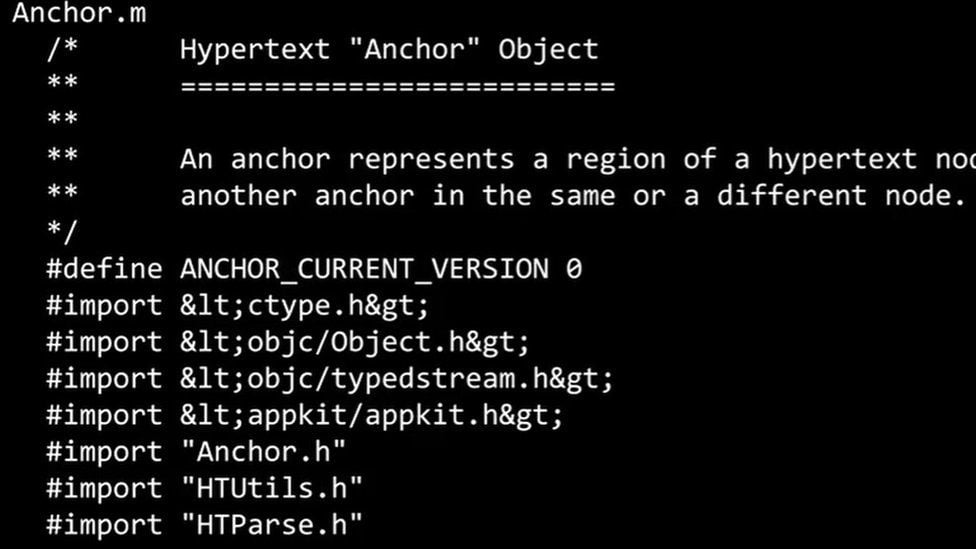
Following the Berners-Lee NFT sale, a coding error was spotted in the NFT video that sold for £3.9 million ($5.4 million). The researcher that spotted the error in the video told BBC News it looked like “a simple mistake.” Mikko Hypponen explains that certain symbols were translated into HyperText Markup Language (HTML) and he believes it was an error.
The error spotted by the researcher – screenshot taken by BBC News, an operational business division of the British Broadcasting Corporation.
“There have already been discussions about whether this would make the NFT more valuable – like a postage stamp with a misprint error,” Hypponen said.
Moreover, website creator Mark O’Neill told the BBC that “whoever made the video for the website ran the original text file through something that converted it into HTML. It’s embarrassing for Sotheby’s but I trust that nobody has done the same to the original code,” O’Neill added.
The BBC’s report notes that the newsdesk had reached out to Sotheby’s and Tim Berners-Lee for comment.
What do you think about Tim Berners-Lee selling an NFT for $5.4 million with an error? Let us know what you think about this subject in the comments section below
While dogecoin and the ERC20 token shiba inu have surprised the masses with phenomenal gains this year, another dog token has entered the fray. A coin project called “Baby Doge” has risen 228.3% during the last 24 hours and even more so after Tesla’s CEO Elon Musk tweeted about the crypto asset.
Another Canine Crypto Coin Sees Its Value Surge
Just when you thought there were plenty of dog meme tokens flooding the market, another canine coin has broken free from the kennel. A new token called baby doge (BABYDOGE) has been the talk of the crypto community the last few days, and Elon Musk decided to tweet about the token on Thursday. Musk’s tweet wasn’t very coherent and he simply said:
Of course, Musk’s tweet sent the baby doge token skyrocketing as the digital currency has risen 228.3% over the last 24 hours. Seven-day stats against the U.S. dollar show baby doge is up 53% this week, and across the last two weeks the coin has jumped 716.9%.
Baby doge has a “woof paper,” an audit, and other documentation concerning this coin.
Information about baby doge can be found on the Binance Smart Chain (BSC) token tracker bscscan.com and the crypto asset has a website called babydogecoin.com.
“Baby Doge Coin has learned a few tricks and lessons from his meme father, Doge,” the web portal says. “A new crypto birthed by fans [and] members of the Dogecoin online community. Baby Doge seeks to impress his father by showing his new improved transaction speeds [and] adorableness,” the website adds. Furthermore, the website notes:
[Baby doge] is Hyper-deflationary with an integrated smart staking system built in to reward you, so more baby doge coins are being automatically added to your wallet each transaction. Simply Love, pet, and watch your baby doge grow.
How Does Baby Doge Compare to the Dogefather and Sibling Shiba Inu?
The dog meme token may be somewhat deflationary by its design as holders of baby doge earn them simply by holding. “Watch the amount of baby doge grow in your wallet as all holders automatically receive a 5% fee from every transaction that happens on the Baby Doge network,” the web portal details.
However, there is an abundant supply of baby doge as bscscan.com and other coin market cap aggregation sites show there are four hundred twenty quadrillion baby doge. That’s very different from the Bitcoin (BTC) network’s max supply of 21 million.
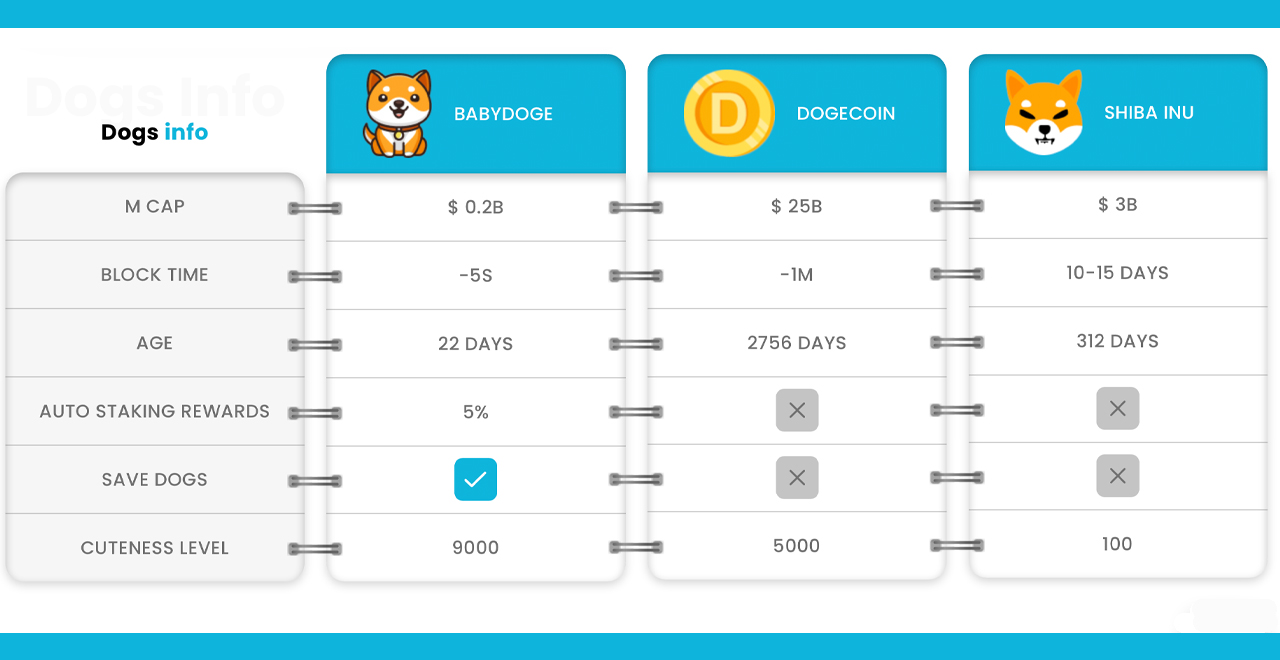
A chart created by the Baby Doge development team shows the differences between DOGE and SHIB.
The coin trades today for less than a U.S. penny at $0.000000001910 per baby doge. It touched an all-time high (ATH) recently, at $0.000000002014 and it’s only down 5% from the ATH. Similar to the shiba inu (SHIB) coin, it’s got a ways to go before it reaches a U.S. penny in value.
SHIB, on the other hand, is much closer than baby doge, at $0.00000839 per SHIB token. The circulating supply of SHIB is a lot less too, with only four hundred ninety-seven trillion SHIB in circulation today.
The one thing baby doge (BABY DOGE) has that outshines its father dogecoin (DOGE) and its sibling shiba inu (SHIB) is lower transaction fees. SHIB, for example, is an ERC20 token and is forced to deal with fees associated with Ethereum, while dogecoin costs over 2 DOGE to send as the average transaction fee on Thursday is around $0.491 per transaction.
Transacting with BSC and baby doge gives users fees as low as 1 gwei (an Ethereum gas measurement), or around 0.000000001 BNB. There’s no fee data on the baby doge token, but a transaction should cost less than a U.S. penny.
What do you think about the Baby Doge project and the coin’s rise this week? Let us know what you think about this subject in the comments section below
With South Africa receiving more than its fair share of cryptocurrency-related scams, a report suggests that regulators are responding to this challenge by fast-tracking the process of creating a new regulatory framework. As a result, regulators now expect this process, which was preceded “by the publication of proposals earlier in June,” to be complete “in three to six months.”
Acknowledging Risks Associated With Crypto
According to a report, under the requirements of the upcoming regulatory regime, players in South Africa’s financial sector are expected to be aware of the risks that are associated with cryptocurrencies. They are also expected to price in those risks properly.
In the meantime, the report also quotes Kuben Naidoo, the CEO at Prudential Authority, a banking sector regulator, explaining how the drafting process is expected to unfold. The CEO said:
We are trying to put in place the regulatory framework quickly. Defining this as a financial product and then developing the regulatory framework is important.
Defeating Scams via Regulation
Meanwhile, the South African regulators’ increased sense of urgency on the issue comes as the country grapples with the Africrypt debacle, the latest high profile cryptocurrency investment platform to collapse.
As previously reported by Bitcoin.com News, Africrypt collapsed soon after its directors Raees and Ameer Cajee fled with investors’ BTC initially believed to be worth billions. Since then, investors have been attempting to locate and recover the missing BTC with the assistance of one South Africa law firm.
Afriypt’s spectacular collapse had been preceded by the demise of Mirror Trading International (MTI) less than six months earlier. Just like Africrypt, MTI collapsed after its CEO Johann Steynberg disappeared with investor funds. Since then, MTI investors have similarly been attempting to recover their funds.
Naidoo, who is also the deputy governor of the South Africa Reserve Bank (SARB), reveals some of the initial steps that regulators plan to take as they seek to avoid a repeat of the MTI and Africrypt type of bitcoin investment scam. One of these steps, according to the report, will include the establishment of know-your-customer rules for crypto exchanges. Additionally, exchanges will be expected to “create systems for the surveillance of the asset class in order to prevent money from being laundered out of the country.”
After this, investor protection guidelines and rules for managing capital risk in the banking sector should come into effect, according to Naidoo.
Do you believe the creation of a regulatory framework will succeed in ending the proliferation of bitcoin scams in South Africa? Tell us what you think in the comments section below.