Powered By Blogger

Saturday, 3 July 2021

Bitcoin Blocks Will Soon Be 27% Easier to Find — Miners Brace for the Largest Difficulty Drop in BTC's Lifetime


Bitcoin, the leading crypto asset in terms of market capitalization, has seen the cryptocurrency’s network hashrate drop considerably during the last two weeks. On Saturday, July 3, the network’s mining difficulty will see the largest epoch drop in history as the difficulty is set to slide by more than 27%.

Bitcoin Difficulty Expected to Drop More Than 27%

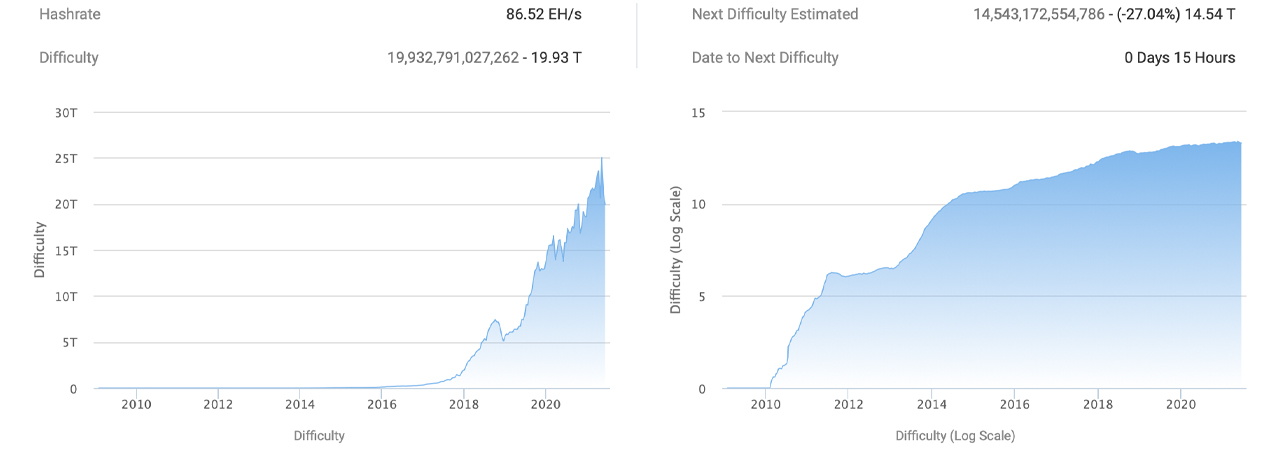
This weekend, Bitcoin (BTC) is set to experience the largest difficulty drop ever recorded during the crypto asset’s lifetime. At the time of writing, BTC’s mining difficulty is 19.93 trillion and is expected to drop 27.04% by Saturday morning (EDT). In bitcoin mining, the network’s difficulty is the parameter that keeps the average time between BTC blocks consistent.

The difficulty parameter is the metric that shows how difficult it is to mine a bitcoin block and the higher the difficulty, the more hashpower is needed to find a block.
Bitcoin Blocks Will Soon Be 27% Easier to Find — Miners Brace for the Largest Recorded Difficulty Drop in BTC's Lifetime
If the difficulty drops by 27% on Saturday, it is expected to be around 14.54 trillion.

When the mining difficulty on the network is lower, it is far easier for bitcoin miners to find blocks. A difficulty that keeps rising alongside the hashrate means an attacker will have to spend enormous amounts of resources to breach the system.

Bitcoin’s upcoming difficulty change comes at a time when Chinese miners have been told to operate elsewhere and a great portion of hashpower went offline this past Monday. During the last BTC difficulty change at block height 687,456 on June 13, 2021, the global hashrate was around 142.68 exahash per second (EH/s).

Since block height 687,456, BTC’s hashrate dropped by 39% to 86.5 EH/s. Bitcoin’s network difficulty has dropped two times prior to the upcoming 27% slide expected on Saturday.

November 2020 and October 2011 Precede Bitcoin’s Largest Difficulty Slide in History

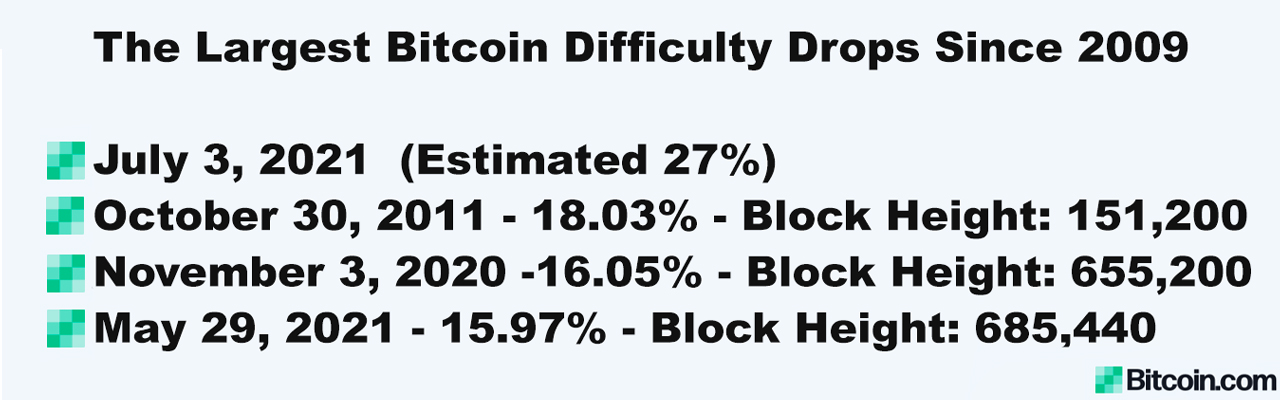
The largest difficulty drop so far in BTC’s lifetime, took place on October 30, 2011, the day before Halloween.
Bitcoin Blocks Will Soon Be 27% Easier to Find — Miners Brace for the Largest Recorded Difficulty Drop in BTC's Lifetime
The difficulty drop on Saturday, July 3, 2021, will be the largest epoch drop in Bitcoin’s history.

At that time, the difficulty slid 18.03 %, at BTC block height 151,200 when the global hashrate was a meager 8.61 terahash per second (TH/s). For some perspective, today a single next-generation bitcoin miner crafted by Microbt or Bitmain commands hashpower of around 100 TH/s.

Interestingly, BTC did not see a large drop like the one in 2011 until block height 655,200 recorded on November 3, 2020. At that time last year, the mining difficulty slid 16.05% and the hashrate was around 120.12 EH/s.

Usually, BTC’s difficulty goes up more so than the number of times it has slid down during the course of its lifetime. At Bitcoin block height 685,440BTC’s mining difficulty slid 15.97% on May 29 when the hashrate was roughly 150 EH/s.

Block Times Expected to Smooth, Hashrate Expected to Increase

At today’s 86.5 EH/s hashrate and the current 19.93 trillion difficulty, block times have been longer than ten minutes on average. After the Bitcoin difficulty change on Saturday, the time between blocks should smooth back over to closer to ten minutes on average.

Since June 29, BTC’s hashrate has increased a great deal as 30-day hashrate statistics show the network’s hashpower was only 66 EH/s that day. Saturday’s difficulty change will not only be a milestone but will also make it much easier for miners to continue ramping up resources.

What do you think about the mining difficulty change set to happen on Saturday? Let us know what you think about this subject in the comments section below

US State Department Official Wants El Salvador to 'Ensure Bitcoin Is Well Regulated'


The U.S. Department of State’s undersecretary of state for political affairs, Victoria Nuland, has explained during a press conference that the U.S. has urged El Salvador to be responsible with the country’s new bitcoin law. Nuland told the press that the U.S. was taking a “tough look at Bitcoin” and that Salvadoran president Nayib Bukele needs to “ensure that it is well regulated.”

State Department Official Says US Is Taking a Tough Look at Bitcoin

According to statements from a senior U.S. State Department official, the U.S. hopes El Salvador will be responsible with the country’s new bitcoin tender law enacted on June 9, 2021. The undersecretary of state for political affairs, Victoria Nuland, explained that she had a meeting with the Salvadoran president Nayib Bukele and they discussed the crypto asset bitcoin (BTC). The American diplomat stressed to Bukele that after the Colonial Pipeline ransomware case, the U.S. was taking “another tough look at bitcoin.”

“I did suggest to the president that whatever El Salvador chooses to do, you ensure that it is well regulated, that it is transparent and that it is responsible, and you protect yourself against malign actors,” Nuland told reporters at the press conference.

El Salvador has had issues getting world leaders to agree with the new bitcoin tender law’s benefits. The World Bank rejected a request from El Salvador for assistance and the president of the European Central Bank (ECB), Christine Lagarde, recently discussed the subject with disparagement. At the time, Lagarde reiterated that the ECB’s policy toward bitcoin (BTC) has not changed. Benoit Coeure, head of the Innovation Hub at the Bank for International Settlements (BIS) also criticized Salvadoran president Nayib Bukele’s bitcoin tender law.

US State Department Claims 14 Salvadorans Associated With President Nayib Bukele ‘Corrupt and Undemocratic’

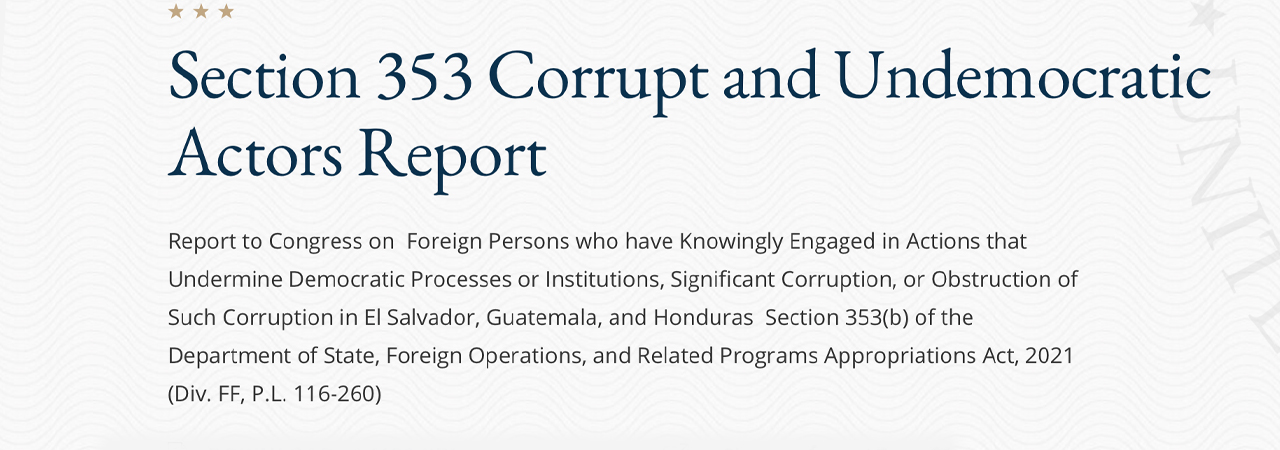
In addition to the senior U.S. State Department official’s statements after meeting with Bukele, the U.S. State Department named 14 Salvadorans that are members of the Bukele regime as “corrupt” and “undemocratic actors.”

US State Department Diplomat Wants El Salvador to Ensure Bitcoin Is This announcement has made people think that the U.S. is cracking down on El Salvador for choosing to leverage bitcoin. “Unconventional Warfare (UW) in action,” explained the popular anonymous analyst Plan B on Twitter. “See link below for what happens to countries that refuse IMF demands [and choose] freedom,” Plan B tweeted.

Economist Steve Hanke: ‘State Department Is Wielding the Hammer’

Even the economist Steve Hanke said: “First, it was El Salvador’s Bitcoin Law. Now, the State Department is wielding the hammer.” Hanke has warned that Salvadoran bitcoin adoption could lead to a “complete collapse of the economy.” Moreover, Hanke and two other authors that publish papers on applied economics at Johns Hopkins University wrote a paper that says: “El Salvador’s bitcoin law is destined to be caught in the FATF’s regulatory web.”

“Under the Bitcoin Law, El Salvador will undoubtedly be ensnared in the Financial Action Task Force’s web of regulations,” Hanke explained on Twitter. “In this working paper, I identify 27 of the FATF’s ‘red-flag’ behaviors that will be impossible for El Salvadorans to comply with.” Victoria Nuland’s recent comments and the U.S. State Department’s “Corrupt and Undemocratic Actors Report” suggest that American bureaucrats agree with Hanke’s opinion.

What do you think about the American diplomat’s recent statements and the U.S. State Department’s latest undemocratic actors report? Let us know what you think about this subject in the comments section below.

Bank of Russia to Study Risks of Crypto Investing With Banks and Payment Providers


The Central Bank of Russia (CBR) has set out to examine the risks associated with cryptocurrency investments. The regulator is going to conduct a dedicated study with the participation of major banks and payment processors operating in the Russian market.

CBR Adds Crypto to Its Survey Program for 2021

Russia’s central bank, known as Bank of Russia, is planning to carry out research regarding the risks that accompany crypto investing. The study titled “Assessment of risks of using cryptocurrencies” has been added to the recently published “Bank of Russia survey program for the second half of 2021.”

Bank of Russia to Study Risks of Crypto Investing With Banks and Payment Providers

The survey will be conducted in order to “obtain information on trends to assess systemic risks in connection with investments of Russian individuals and legal entities in cryptocurrency,” CBR explained in a note. The regulator will send out questions to a number of financial market participants, including 15 banks such as VTB, Tinkoff, Alfa-Bank, Raiffeisenbank, and the state-owned banking giant, Sberbank.

Bank of Russia also wants its study to feature input from the global payment systems Visa and Mastercard, as well as the Russian Mir, RBC reported. Payment service providers like Юkassa, Webmoney, Qiwi, and Western Union should expect to receive the central bank’s questionnaire too. The data submission deadline has been set to July.

Central Bank of Russia Remains Hostile to Cryptocurrencies

Over the past few years, the central bank of Russia has maintained a negative attitude towards cryptocurrencies. Moscow’s monetary policy regulator remains firmly opposed to accepting the decentralized digital money as a means of payment in the Russian Federation, where the ruble is the only legal tender by law. Bank of Russia is working on a digital version of the national fiat and aims to unveil a ‘digital ruble’ prototype by the end of 2021.

In June, the head of the CBR, Elvira Nabiullina, advised against crypto investments, referring to “speculative cryptocurrencies” as “the most dangerous of all strategies” for investors. “The price is very volatile and the losses can be enormous,” Nabiullina warned. She was also quoted by Komsomolskaya Pravda as saying:

The central bank never gives advice on where to invest, but in this particular case – [investing] here is definitely not necessary.

Early last month, Nabiullina called cryptocurrencies a monetary surrogate and voiced opposition to their use in the country. Russian legislation prohibits the issuance and circulation of “money surrogates.” At the same time, the CBR chairwoman admitted it’s difficult to restrict the crypto market at the national level since it is fundamentally transnational.

Why do you think Bank of Russia wants to conduct a crypto survey? Share your thoughts on the subject in the comments section below

Venezuela to Slash Six Zeros From Its Currency to Facilitate Payments


The government of Venezuela is considering a new redenomination of its fiat currency. The proposal that is under study would cut six zeroes from the inflation-affected Bolivar. This would aid companies in processing taxes and provider payments that are absurdly complex with today’s numbers. However, the dollar is the predominant coin in retail payments in Venezuela, according to consulting firms.

Venezuela to Redenominate Its Currency

The government of Venezuela is studying a mathematical redenomination of its currency, the sovereign bolivar, to simplify payments for big companies. This redenomination would slash six zeros, making it easier to calculate payments now reaching high sums. While there has not been an official announcement yet, Bloomberg reported this subject was commented on by three people with knowledge of the matter.

The new measure comes to aid companies who had to make big payments in bolivars. This would also aid consumers paying in bolivars using POS terminals, who now have to swipe their cards several times due to system limits. However, this measure shows the government has failed in controlling inflation and devaluation of the currency. The bolivar now trades at approx. 3,200,000 VES per dollar (or 3.2 redenominated VES per dollar).

Most of the payments in the country are now digital, so the government would not have to print many bills to substitute the amount of cash present in the market. According to some estimations made by Econometrica, a national consulting agency, only 1.9% of the money in the Venezuelan system is cash. The highest note has a value of 1,000,000 VES, or about $0.30, and is only useful to pay for bus fares.

Not the First Time

This is not the first time Venezuela’s central bank will have taken such a measure. In fact, citizens have already gone through this process twice. The first event of monetary reconversion happened in 2008, and it slashed three zeros from the bolivar. At that time, the country was in a very different situation, with interannual inflation of only 20.44%.

The second conversion was applied not so long ago, in 2018, and it deleted five zeros from the currency. This time, Venezuela was in dire straits, facing a hyperinflationary process and the start of sanctions that would impact economic development. Around that time, the government launched Petro, its official cryptocurrency, as an attempt of countering this situation.

This means that in less than 15 years, Venezuela will have slashed 14 zeroes off of its currency. But, without any effective measures to counter inflation, this only serves as a bandaid for some citizens affected by the current situation.

What do you think about the latest fiat currency redenomination in Venezuela? Tell us in the comments section below.

KATY PERRY WILL BE DROPPING NFT COLLECTION THIS YEAR


On Wednesday, 30th June, Global Pop star Katy Perry made a statement that she will be dropping her own non-fungible collection later this year. She added she would also be making a purchase in Theta Labs of a minority stake. Theta Labs is a firm based on a decentralized p2p video streaming platform; it uses Blockchain technology.

From the information received through Theta Labs’ press release, Perry’s partnership with Theta Labs will involve the sellings of digital Collectables derived from her upcoming “play” residency this December in Las Vegas.

Perry tweeted to her fans, asking them to check out her memorable and creative arts moments from her residency that’ll be a real-life experience as well as in the form of digital Collectables.

According to ThetaDrop, the NFT platform of Theta network, the possibility of commencement of NFTs actual sale can Come around in Q4 of 2021.

Musicians’ involvements with NFTs

The music business is in a condition of transition. The end of the digital downloads and sales of CDs in order to support online music streaming has altogether choked benefits – especially for the singers themselves.

Katy Perry is not the only celebrity to drop her NFT collection this year. In late May, The well-celebrated boxer Floyd Mayweather also inaugurated an NFT collection. The NFT market has gotten its support from the rapper Jay-Z as well — particularly in the accession of his music streaming platform, Tidal.

Perceiving the size of this shift, the Department of Culture, Media and Sport  select council of the United Kingdom

has also gathered proof on how the billions of dollars are yielded by services like  Apple Music, Spotify, and Amazon Music.

Before the pandemic, artists were heavily dependent on musical tours for profits.

But due to the current situation, live music is facing an unstable future; hence the capability of NFTs to add to the income carries enormous appeal.

According to the Finance teacher at Sussex University, Carol Alexander,

The huge appeal of NFT is particularly evident in light of the fact that it offers artists the opportunity to sidestep the wrap of the label, publisher, and distributor rights. NFTs permit musical bands to remove the costs and problems because of countless intermediaries and save their time by directly selling to their fan base.  

In addition to the expanded benefit share, the artist gets the opportunity to coordinate where the cash goes, too!

Conclusion

While the carbon emission of NFTs has always been a debated topic because of the energy consumption of the POW (proof-of-work) based Ethereum network, the Theta network’s blockchain utilizes a POS (proof-of-stake) prototype that intends to mitigate energy usage. 

However, looking at Perry’s financial stake in the Theta network gives out a clear indication that the pop star may be looking forward to future projects under the blockchain platform.