The Breakdown is written, produced by and features NLW, with editing by Rob Mitchell and additional production support by Eleanor Pahl. Adam B. Levine is our executive producer and our theme music is “Countdown” by Neon Beach. The music you heard today behind our sponsor is “Razor Red” by Sam Barsh. Image credit: hamzaturkkol/iStock/Getty Images Plus, modified by CoinDesk.
Hawkish comments from BOE members keep GBP supported
GBP/USD struggles to keep hold as EUR/GBP looks to break out of descending channel
Despite a tough week for GBP/USD the Pound remains supported by expectations of a more hawkish Bank of England. The lead-up to the August MPC meeting is drawing more attention as markets increase odds that the BOE will start amending its monetary policy to adapt better to current economic conditions.
Michael Saunders was the focus point on Thursday when he mentioned that inflation could prove to be stubbornly high in the coming months, hinting at the possibility of an interest rate in the first half of 2022. Prior to that, Ramsden had made a similar argument regarding the rapid developments since the last forecast was published in May, which had allowed for considerations of tapering sooner than originally expected.
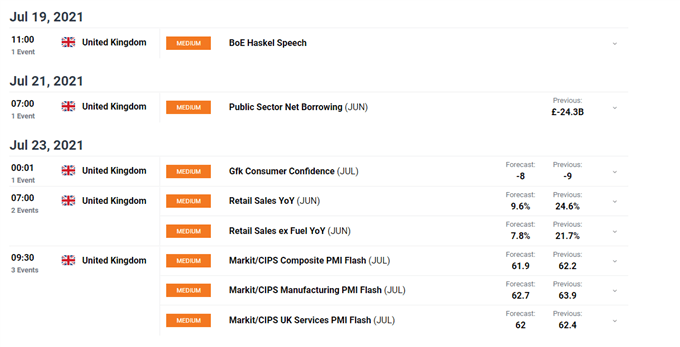
Looking ahead at the UK calendar for next week, we’ll have another BOE member speaking on Monday (Haskel) and then little else until the June retail sales and PMIs are published on Friday.
Despite a tough week for GBP/USD the Pound remains supported by expectations of a more hawkish Bank of England. The lead-up to the August MPC meeting is drawing more attention as markets increase odds that the BOE will start amending its monetary policy to adapt better to current economic conditions.
Michael Saunders was the focus point on Thursday when he mentioned that inflation could prove to be stubbornly high in the coming months, hinting at the possibility of an interest rate in the first half of 2022. Prior to that, Ramsden had made a similar argument regarding the rapid developments since the last forecast was published in May, which had allowed for considerations of tapering sooner than originally expected.
Looking ahead at the UK calendar for next week, we’ll have another BOE member speaking on Monday (Haskel) and then little else until the June retail sales and PMIs are published on Friday.
UK ECONOMIC CALENDAR PROVIDED BY DAILYFX
Looking at GBP crosses, GBP/USD is threatening to break below 1.30 if the pair is unable to hold above its 200-DMA (1.3808) going into the new week. The Stochastic is showing a slightly negative bias in the short term but there is still room for a swing upwards towards 1.39, which is proving to be a tough resistance to crack. For EUR/GBP the pressure continues to be tilted to the downside as the pair was nearing the 0.85 mark earlier on in the week as it attempts to consolidate and break out of the descending channel it has been trading in for the last 3 months. A break below this area is likely to lead to a new attempt at breaking below the yearly low seen in April at 0.8472.
Binance has been warned by regulators in the country it is based, the Securities and Futures Commission (SFC) of Hong Kong, to stop providing “stock tokens” services.
“SFC wishes to make it clear that no entity in the Binance group is licensed or registered to conduct ‘regulated activity’ in Hong Kong,” they say.
Binance quickly complied, stating “we are announcing that we will be winding down support for stock tokens on Binance.com to shift our commercial focus to other product offerings. Effective immediately, stock tokens are unavailable for purchase on Binance.com, and Binance.com will no longer support any stock tokens after 2021-10-14 19:55 (UTC).”
They have a partnership with CM-Equity AG, a licensed investment firm in Germany, and say they may move Europeans there.
“Users may transition their stock token balances to CM-Equity AG once its new portal is established,” Binance said.
This is the latest regulatory action against the global crypto exchange based in Hong Kong which has been under the scrutiny of US authorities.
They were founded in an Initial Coin Offering (ICO) in 2017 which gave rise to both Binance the exchange and the BNB token now operating in the Binance Chain.
Their initial base in Japan faced regulatory difficulties as FSA there did not license them. So they moved to Malta, but a change of administration led to the Maltese authorities clarifying that “Binance is not authorised by the MFSA to operate in the crypto currency sphere.”
Since then speculation has intensified regarding their headquarters with Binance putting their HQ on Linkedin as “everywhere.”
Changpeng Zhao, Binance’s CEO, has refused to state in interviews where they are based, giving rise to rumors that Cayman Island is their HQ or Seychelles.
The Cayman Islands financial authority (CIMA) also said earlier this month Binance does not have a license there and they are investigating “whether Binance, the Binance Group, Binance Holdings Limited or other companies affiliated with this group of companies have activities operating on or from within the Cayman Islands that may fall within the scope of the Authority’s regulatory oversight.”
Binance’s own terms and conditions, however, have Hong Kong as its jurisdiction, stating:
“These Terms (including this arbitration agreement) shall be governed by, and construed in accordance with, the laws of Hong Kong.”
Hence Binance.com itself now has to comply with whatever Hong Kong authorities say, while previously actions from UK’s FCA and other jurisdictions had as response something akin to: a subsidiary operates there and thus Binance.com is not affected, we’ll just launch binance.[country].
That’s unless Binance moves again, with the exchange operating in somewhat of a gray zone as it was publicly funded from the get go, unlike Coinbase which was privately funded and opened to the public only after it reached a valuation of $100 billion.
The global public, by having the choice to invest in Binance from the get go, has greatly benefited from the success of the exchange. While the public has not benefited at all from the success of Coinbase as they were prohibited from investing in it for the first nine years of its existence when it saw massive growth.
Something the United States regulators do not like as such US prohibition in public funding of startups can only work if it is global.
It’s not clear however why Europe in particular, which is the only globally respected jurisdiction that can stand up to the United States, is not providing a home of sorts.
One reason might be because Zhao has not quite asked them. They picked the tiny jurisdiction of Malta instead, when it could have been very different if it was Germany, or one of its principates like Luxembourg and Liechtenstein, or France.
That may well be the way they have to go especially as they already have a partnership with CM-Equity AG. Then the exchange would be outside of US’s global jurisdiction, which clearly also includes tiny Hong Kong, but of course they’ll have to comply with European law.
However, they’ll potentially have the opportunity to shape or influence such laws with both Germany and France keen to provide jurisdictional competition by taking a different approach to this ancient prohibition in startups public financing.
But what Zhao will do remains to be seen with his options limited now that his home country, China, has turned hostile towards cryptos.
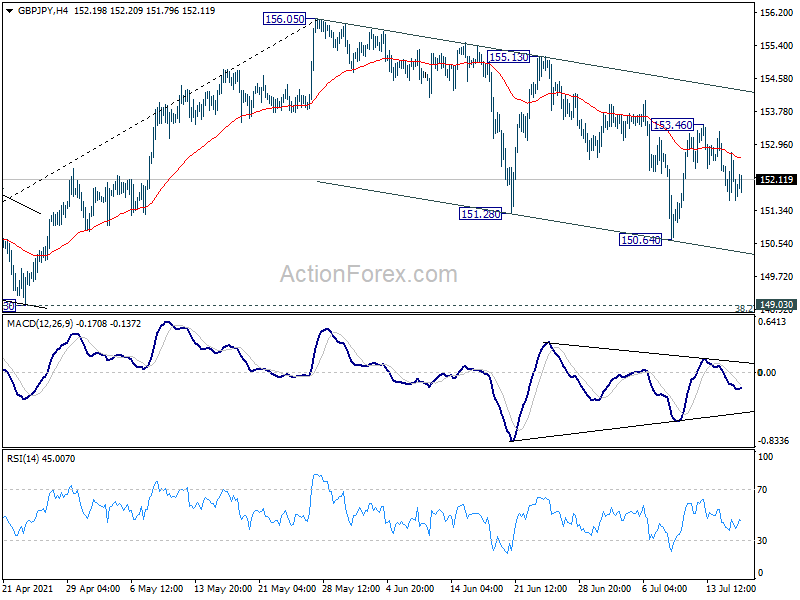
Intraday bias in GBP/JPY remains neutral at this point. Correction from 156.05 could still extend lower. Break of 150.64 will target 149.03 cluster support level. On the upside, break of 153.46 will turn bias back to the upside for 155.13/156.05 resistance zone.
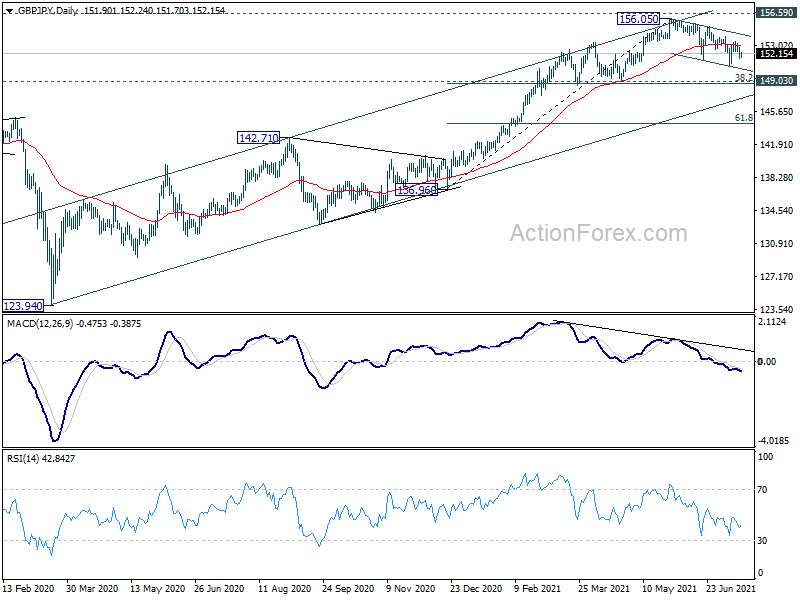
In the bigger picture, rise from 123.94 is seen as the third leg of the pattern from 122.75 (2016 low). Focus remains on 156.59 resistance (2018 high). Sustained break there should confirm long term bullish trend reversal. Next target is 61.8% retracement of 195.86 (2015 high) to 122.75 at 167.93. On the downside, break of 149.03 support is needed to be the first sign of completion of the rise from 123.94. Otherwise, outlook will remain bullish even in case of deep pull back.
A marubozu candle only has a body. It doesn’t have wick or tail.
Bullish marubozu is a long green body candle
Bearish marubozu is a long red body candle
Statistics to prove if the Marubozu pattern really works
Are the odds of the Marubozu pattern in your favor?
How does the Marubozu behave with a 2:1 target R/R ratio?
From our research the Marubozu pattern confirms 88.3% of the time on average overall all the 4120 markets we analysed. Historically, this patterns confirmed within 0.6 candles or got invalidated within 4.2 candles. If confirmed, it reached the 2:1 R/R target 30.5% of the time and it retested it's entry price level 98.6% of the time. Not accounting for fees, it has an expected outcome of -0.085 $/$. It means for every $100 you risk on a trade with the Marubozu pattern you lose $8.5 on average. Want to account for your trading fees? Have the detailled stats for your favorite markets / timeframes? Or get the stats for another R/R than 2:1? 🚀 Join us now and get fine-tuned stats you care about!
How to handle risk with the Marubozu pattern?
We analysed 4120 markets for the last 59 years and we found 538 662 occurrences of the Marubozu pattern. On average markets printed 1 Marubozu pattern every 29 candles.
For 2:1 R/R trades, the longest winning streak observed was 13 and the longest losing streak was 598. A trading strategy relying solely on this pattern is not advised. Anyway, make sure to use proper risk management.
Keep in mind all these informations are for educational purposes only and are NOT financial advice.
What is the Marubozu candlestick pattern?
Marubozu means “bald head” or “shaved head” in Japanese, and this is shown in the absence of wicks or shadow on the candlestick, meaning that the opening or closing price will be the same as the maximum prices of the candle. The absence of shadow indicates that the trading session opened at a high price and close at a low price at the end of the day (or the opposite). The Marubozu candlestick pattern can provide analytical insight into the future direction of the price of a stock.
How to identify the Marubozu candlestick pattern?
It is fairly easy to identify a marubozu pattern because it is a single candlestick having a real body without any kind of shadows. Typically, when bullish, they are white or green on stock charts and when bearish, they are red or black. In bearish marubozu, the open price is equal to the high price and the close price is equal to the low price. For bullish marubozu, the open price is equal to the low price and the close price is the same as the high price.
The identification mark for an ideal spinning top will be:
A large real body
There will be no shadow at either sides of the candle
The color of the candle will be of a significant meaning
In actual market conditions, a perfect marubozu is rare. Therefore, there is a minor difference sometimes – usually less than 0.01 percent of the candle range, between the open/close prices with high/low price is neglected when identifying a marubozu.
Bullish & Bearish Marubozu pattern
What does the Marubozu pattern tell traders?
Marubozu candlesticks can be found on all stock charts and all time frames. Depending on who controlled the day, they can either be bullish or bearish. They are used with technical analysis to show how a stock traded for the day. Usually, stock trading is a competition between buyers and sellers. There are days when one side wins by far, therefore the formation of the marubozu candlestick pattern.
It is a single candlestick pattern that can give insight into the sentiments of the market at a given time. Basically, its appearance means that the market traded to the close without any lasting retracement.
How to trade when you see the Marubozu pattern?
The color of the candlestick shows that either the sellers or buyers have full control of the market. The style of trading will vary depending on the type of marubozu. Before entering a trade, it is advisable for you to wait for another confirmation pattern or candle.
Trading with Bullish Marubozu
The absence of a lower and upper shadow in a bullish marubozu indicates that the low price is the same as the open price and the high price is equal to the close price. Therefore, when you see a candle with open=low and close=high, that is called a bullish marubozu.
This kind of candlestick shows that there is so much buying interest in the stock or the market participants are willing to buy the stock at any price during that trading session. Hence, the price of the stock closed near the high point for that session. If the bullish marubozu is shown at an uptrend, this strongly implies a trend continuation. But when it appears in a downtrend, it shows a trend reversal, that the sentiment of the market has changed and the stock is now bullish.
It is expected that when this sharp change happens, there will be a surge of bullish patterns that are likely to persist over the next trading sessions. Therefore, a trader should look for buying opportunities after the occurrence of a bullish marubozu. It is suggested that the buy price is slightly above the closing price of the bullish marubozu.
Trading with Bearish Marubozu
A bearish marubozu shows that the high price is equal to the open price and the low price is equal to the close price. Therefore, when you see a candle with open=high and close=low, that can be called a bearish marubozu.
This shows that the sellers are in total control of the market. There is so much selling pressure on the stock that the participants of the market are willing to sell the stock at any point during the trading session. Hence, the price of the stock closed near the low point for the session. If the bearish candlestick appears in a downtrend, it means a strong trend continuation. But if it appears in an uptrend, it works as a trend reversal pattern, that is, the sentiment of the market has changed and the stock is now bearish.
It is expected that with this sharp sentiment change there will be a surge of bearishness and it will continue over the next few trading sessions. Therefore, a trader should look for opportunities to sell after the occurrence of a bearish marubozu. The suggested selling price is slightly below the closing price of the marubozu.
How to avoid false Marubozu signals and setting stop-loss
In most instances, the stop-loss for any trade taken on the basis of a marubozu candlestick should be low or high of the candle. Although marubozu is a strong candlestick pattern, it is wise to avoid extremely small (less than 0.5 percent range) or long candle (over 5 percent range).
A candle that is extremely small means a reduced trading activity and therefore it may be a false signal. At the same time, a long candle indicates extreme activity and in that case, the stop-loss for the trade will be deep. Because of this, avoid trading on candles that are either too long or too short. Also, take additional confirmation from another pattern or technical analysis before going into a trade.
Basically, when trading marubozu candlesticks,
Watch for bullish or bearish candlesticks to form
If bullish, take a long when price breaks above
Place stop below candlesticks
If bearish, take a short when price falls below
Place a stop above candlestick
Summary
Marubozu candlesticks can be seen in all chart time frames. One signal alone is not enough to justify a trade. It is necessary to see what the technical analysis is indicating as well as the patterns they are part of. It might seem easy for you to trade during the day using marubozu candlestick patterns, since one side is in control of the day. Take time to study the candlesticks to sharpen your trading skills.
How does the Marubozu pattern look in real life?
stock PHM printed a bullish Marubozu on 2004-12-15. Unfortunately it invalidated on 2005-01-04 before the trade could trigger (it triggered the stop before entering).
stock PHM printed a bullish Marubozu on 2019-08-06 17:30:00. Unfortunately it invalidated on 2019-08-07 13:30:00 before the trade could trigger (it triggered the stop before entering).
stock PVH printed a bullish Marubozu on 2019-03-05 18:30:00. Unfortunately it invalidated on 2019-03-06 14:30:00 before the trade could trigger (it triggered the stop before entering).