Powered By Blogger

Tuesday, 20 July 2021

GBPUSD and USDCAD Breakout Dispute EURUSD Hold as Risk Trends Plunge


S&P 500Crude Oil, Risk Trends, Dollar and GBPUSD Talking Points:

  • Despite an empty docket to start this week, markets opened to a broad and intense risk aversion with motivation coming as an after thought
  • The S&P 500 broke trendline support and the Dow suffered its worst day in 8 months, but potential arises from the breadth of the risk aversion
  • While the Delta variant, growth and monetary policy were all in headlines; risk aversion seemed to be the root of the market’s move

An Unexpected Fire In US Equities

If we were going by the economic calendar, it was looking like we were heading into the full lull of the summer doldrums. What we have seen thus far could not be further from those expectations. A strong downdraft in some of the most closely watched risk assets proved not simply an isolated bout of volatility. The risk aversion proved broad for both region and asset type which goes a long way to raising the threat that this was not simply a short-lived shudder from a thinned market. All traders should be on high alert, but there is strong precedence recently to maintain a sense of skepticism given a host of false starts across the financial system over these past months. It is difficult to override an undercurrent of illiquidity and upend a deep complacency born out of borrowed time and massive stimulus programs. As such, I’m eying the S&P 500’s first break of trendline support stretching back to the post-pandemic recovery and the Dow’s biggest daily drop since October for evidence that momentum is shifting to full panic-led deleveraging.

Chart of the S&P 500 with 20 and 100-Day Moving Avgs and Gaps (Daily)

Chart Created on Tradingview Platform

One of the more reliable measures for carrying forward a systemic sentiment shift is to establish a fundamental root to the move. Event risk in the opening 48 hour of this week (Monday behind us and Tuesday ahead) is particularly light and doesn’t get close to hitting the nerve of the more effective themes that have driven the market lately. A growing reference in headlines and in trader circles is the reference to the rising numbers of coronavirus cases in countries like the US that are reopening as the Delta variant spreads. Alternatively, the slowing in growth trends seen in recent data points (and perhaps with Friday’s PMIs) could give weight to the breakdown in crude oil and the US 10-year Treasury yield. Or, perhaps the recognition of a global shift in monetary policy towards normalizing from an extremely easy path is finally catching up to speculators after weeks of building evidence? It is all possible, but I believe this is more of a risk-first move with explanation coming later. This could prove the most capable universal motivation for markets, but it could also snuff out a nascent trend should liquidity dry up quickly.

Chart of Crude Oil Active Futures Price with Volume, 20 and 100-SMA and 1-Day Change (Daily)

Chart Created on Tradingview Platform

Visualized another way, the below intensity curve helps me better assess the standings of conviction. When risk trends take command of investors the world over, it can be difficult the momentum that results. However, getting that traction in the first place can prove quite the feat. While there was some moderate risk aversion to end this past week, the truly comprehensive move didn’t register until Monday. After correlation and intensity, follow through is the most important feature of a productive trend. At what point does one call a trend? That’s up for discretion, but at a minimum I would look for a second day’s follow through.

Chart of S&P 500 Overlaid with Aggregate of Major Central Banks’ Stimulus (Monthly)

Chart Created by John Kicklighter with Data from Central Banks

The Dollar’s Bullish Break Doesn’t Register as an ‘Extreme’ Haven Demand

While much of the interest through the opening session of the week may have gone to indices and other overt risk measures, I was also keeping an eye on assets that orient more towards the haven side. In particular, the FX market’s Dollar and Yen crosses were of particular interest. For the Yen pairs, there was a broad enough slide (the Japanese currency rising) that it would also pull down USDJPY. That is a combination of two generic havens, but the Greenback usually appeals in more extreme scenarios. If we were to look at the Dollar by itself, the DXY trade-weighted index struggled to push higher. That said, it is heavily weighted towards EURUSD, a pair that is rooted more in its liquidity rather than its ‘risk’ contrast. If there is a second day of risk aversion, however, the smallest 10-day range in 18 months is likely to provide a critical break.

Chart of the EURUSD with 20 and 100-SMA and 10-Day Historical Range (Daily)

Chart Created on Tradingview Platform

Elsewhere, managed to produce some impressive bullish breakouts against key counterparts. GBPUSD isn’t particularly known for its contrast on the risk spectrum, but it seemed tuned to the day’s volatility. A break of 1.3700 has brought the pair to a six month low by way of a prominent trendline support breakdown and subsequent clearance of the 200-day moving average – the first slip below this measure in 257 trading days.

Chart of the GBPUSD with 100 and 200-Day Moving Average (Daily)

Chart Created on Tradingview Platform

Another incredibly impressive break in the Dollar’s favor came from USDCAD. Already measuring out progress – like the AUDUSD’s head-and-shoulders break a month ago – the ‘Loonie’ cross similarly cleared its own 200-day moving average over a similar time frame as well as the historical midpoint for the pair at 1.2600. For scale this is perhaps the most impressive clearance. Yet, for it to truly matter, there needs to be follow through. A break alone, even one as steeped in technical renown as this, is no guarantee of trend.

Chart of the USDCAD with 100 and 200-Day Moving Average and 1-Day Rate of Change (Daily)


Monday, 19 July 2021

Why Governments Should Invest in Bitcoin Infrastructure


An argument that the Bitcoin network is a public good and governments should invest in public goods.

This episode is sponsored by NYDIG.

Download this episode

This week’s “Long Reads Sunday” is a reading of “Bitcoin: An Orange New Deal” by Andrew Bailey and Bradley Rettler.

See also: Bitcoin Doesn’t Care About Your Politics: Why Bitcoin Has More Ideological Flexibility Than We Think

The Breakdown is written, produced by and features NLW, with editing by Rob Mitchell and additional production support by Eleanor Pahl. Adam B. Levine is our executive producer and our theme music is “Countdown” by Neon Beach. The music you heard today behind our sponsor is “Razor Red” by Sam Barsh. Image credit: hamzaturkkol/iStock/Getty Images Plus, modified by CoinDesk.

British Pound (GBP) Weekly Forecast: On Alert for Comments from BOE Members Forex Daily Outlook

GBP ANALYSIS & NEWS

  • Hawkish comments from BOE members keep GBP supported
  • GBP/USD struggles to keep hold as EUR/GBP looks to break out of descending channel

Despite a tough week for GBP/USD the Pound remains supported by expectations of a more hawkish Bank of England. The lead-up to the August MPC meeting is drawing more attention as markets increase odds that the BOE will start amending its monetary policy to adapt better to current economic conditions.

Michael Saunders was the focus point on Thursday when he mentioned that inflation could prove to be stubbornly high in the coming months, hinting at the possibility of an interest rate in the first half of 2022. Prior to that, Ramsden had made a similar argument regarding the rapid developments since the last forecast was published in May, which had allowed for considerations of tapering sooner than originally expected.

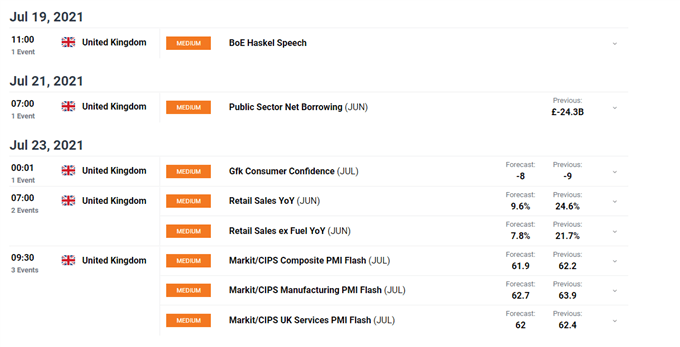
Looking ahead at the UK calendar for next week, we’ll have another BOE member speaking on Monday (Haskel) and then little else until the June retail sales and PMIs are published on Friday.

Despite a tough week for GBP/USD the Pound remains supported by expectations of a more hawkish Bank of England. The lead-up to the August MPC meeting is drawing more attention as markets increase odds that the BOE will start amending its monetary policy to adapt better to current economic conditions.

Michael Saunders was the focus point on Thursday when he mentioned that inflation could prove to be stubbornly high in the coming months, hinting at the possibility of an interest rate in the first half of 2022. Prior to that, Ramsden had made a similar argument regarding the rapid developments since the last forecast was published in May, which had allowed for considerations of tapering sooner than originally expected.

Looking ahead at the UK calendar for next week, we’ll have another BOE member speaking on Monday (Haskel) and then little else until the June retail sales and PMIs are published on Friday.

UK ECONOMIC CALENDAR PROVIDED BY DAILYFX

British Pound (GBP) Weekly Forecast: On Alert for Comments from BOE Members

Looking at GBP crosses, GBP/USD is threatening to break below 1.30 if the pair is unable to hold above its 200-DMA (1.3808) going into the new week. The Stochastic is showing a slightly negative bias in the short term but there is still room for a swing upwards towards 1.39, which is proving to be a tough resistance to crack. For EUR/GBP the pressure continues to be tilted to the downside as the pair was nearing the 0.85 mark earlier on in the week as it attempts to consolidate and break out of the descending channel it has been trading in for the last 3 months. A break below this area is likely to lead to a new attempt at breaking below the yearly low seen in April at 0.8472.

GBP/USD DAILY CHART & EUR/GBP WEEKLY CHART


Binance Warned by its Headquarters Jurisdiction


Binance has been warned by regulators in the country it is based, the Securities and Futures Commission (SFC) of Hong Kong, to stop providing “stock tokens” services.

“SFC wishes to make it clear that no entity in the Binance group is licensed or registered to conduct ‘regulated activity’ in Hong Kong,” they say.

Binance quickly complied, stating “we are announcing that we will be winding down support for stock tokens on Binance.com to shift our commercial focus to other product offerings. Effective immediately, stock tokens are unavailable for purchase on Binance.com, and Binance.com will no longer support any stock tokens after 2021-10-14 19:55 (UTC).”

They have a partnership with CM-Equity AG, a licensed investment firm in Germany, and say they may move Europeans there.

“Users may transition their stock token balances to CM-Equity AG once its new portal is established,” Binance said.

This is the latest regulatory action against the global crypto exchange based in Hong Kong which has been under the scrutiny of US authorities.

They were founded in an Initial Coin Offering (ICO) in 2017 which gave rise to both Binance the exchange and the BNB token now operating in the Binance Chain.

Their initial base in Japan faced regulatory difficulties as FSA there did not license them. So they moved to Malta, but a change of administration led to the Maltese authorities clarifying that “Binance is not authorised by the MFSA to operate in the crypto currency sphere.”

Since then speculation has intensified regarding their headquarters with Binance putting their HQ on Linkedin as “everywhere.”

Changpeng Zhao, Binance’s CEO, has refused to state in interviews where they are based, giving rise to rumors that Cayman Island is their HQ or Seychelles.

The Cayman Islands financial authority (CIMA) also said earlier this month Binance does not have a license there and they are investigating “whether Binance, the Binance Group, Binance Holdings Limited or other companies affiliated with this group of companies have activities operating on or from within the Cayman Islands that may fall within the scope of the Authority’s regulatory oversight.”

Binance’s own terms and conditions, however, have Hong Kong as its jurisdiction, stating:

“These Terms (including this arbitration agreement) shall be governed by, and construed in accordance with, the laws of Hong Kong.”

Hence Binance.com itself now has to comply with whatever Hong Kong authorities say, while previously actions from UK’s FCA and other jurisdictions had as response something akin to: a subsidiary operates there and thus Binance.com is not affected, we’ll just launch binance.[country].

That’s unless Binance moves again, with the exchange operating in somewhat of a gray zone as it was publicly funded from the get go, unlike Coinbase which was privately funded and opened to the public only after it reached a valuation of $100 billion.

The global public, by having the choice to invest in Binance from the get go, has greatly benefited from the success of the exchange. While the public has not benefited at all from the success of Coinbase as they were prohibited from investing in it for the first nine years of its existence when it saw massive growth.

Something the United States regulators do not like as such US prohibition in public funding of startups can only work if it is global.

It’s not clear however why Europe in particular, which is the only globally respected jurisdiction that can stand up to the United States, is not providing a home of sorts.

One reason might be because Zhao has not quite asked them. They picked the tiny jurisdiction of Malta instead, when it could have been very different if it was Germany, or one of its principates like Luxembourg and Liechtenstein, or France.

That may well be the way they have to go especially as they already have a partnership with CM-Equity AG. Then the exchange would be outside of US’s global jurisdiction, which clearly also includes tiny Hong Kong, but of course they’ll have to comply with European law.

However, they’ll potentially have the opportunity to shape or influence such laws with both Germany and France keen to provide jurisdictional competition by taking a different approach to this ancient prohibition in startups public financing.

But what Zhao will do remains to be seen with his options limited now that his home country, China, has turned hostile towards cryptos.


Sunday, 18 July 2021

GBP/JPY Daily Outlook

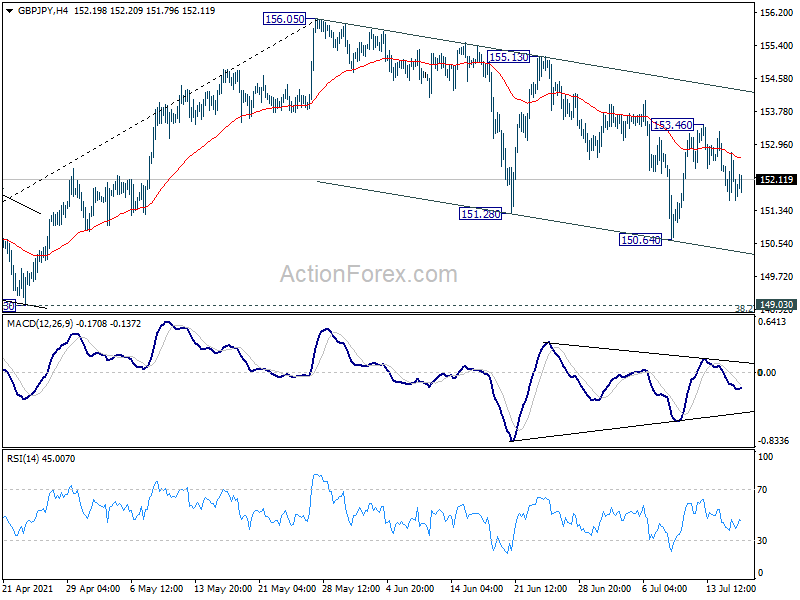
Intraday bias in GBP/JPY remains neutral at this point. Correction from 156.05 could still extend lower. Break of 150.64 will target 149.03 cluster support level. On the upside, break of 153.46 will turn bias back to the upside for 155.13/156.05 resistance zone.

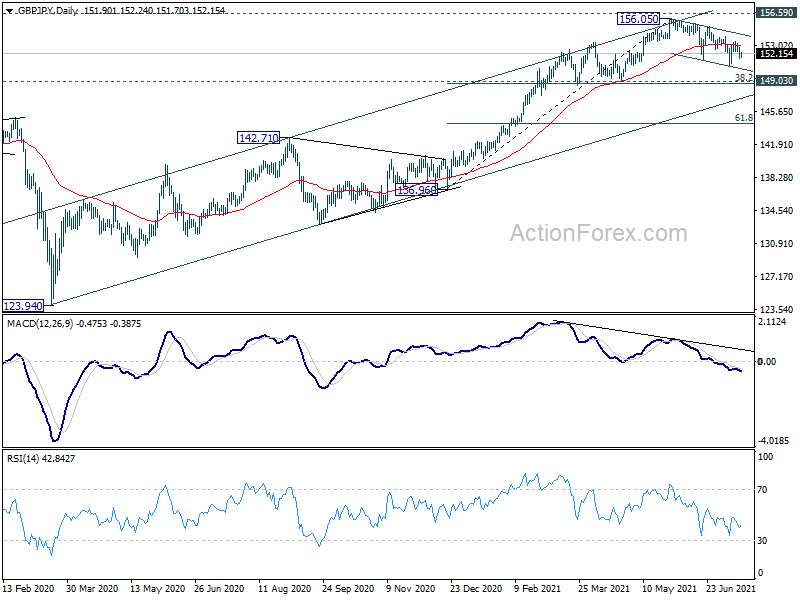
In the bigger picture, rise from 123.94 is seen as the third leg of the pattern from 122.75 (2016 low). Focus remains on 156.59 resistance (2018 high). Sustained break there should confirm long term bullish trend reversal. Next target is 61.8% retracement of 195.86 (2015 high) to 122.75 at 167.93. On the downside, break of 149.03 support is needed to be the first sign of completion of the rise from 123.94. Otherwise, outlook will remain bullish even in case of deep pull back.