Powered By Blogger

Saturday, 12 February 2022

13 Years Ago Today, Satoshi Nakamoto Published the First Forum Post Introducing Bitcoin

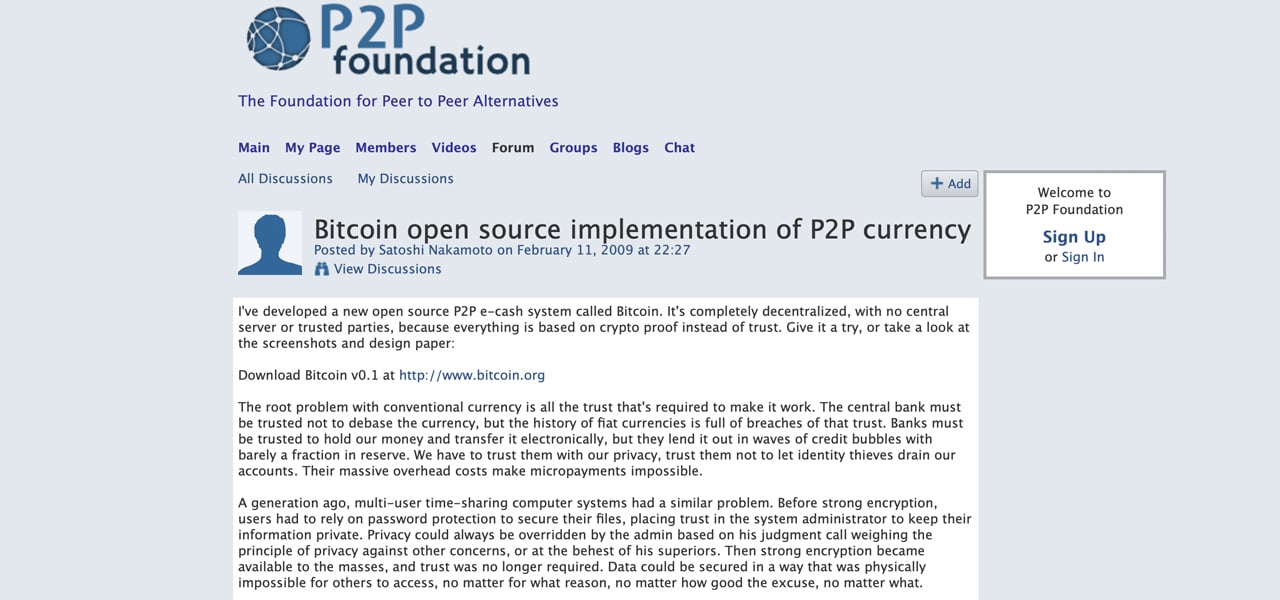
13 years ago today, the creator of the Bitcoin network, Satoshi Nakamoto published the inventor’s first forum post on the P2P Foundation website. The forum post called “Bitcoin open source implementation of P2P currency” introduced the e-cash system to the members of the advocacy and research forum focused on peer-to-peer dynamics in society.

The First of 3 February 2009 Forum Posts Introducing Bitcoin

There was three occasions in February 2009 when Satoshi Nakamoto introduced the inventor’s Bitcoin white paper and open source codebase to the P2P Foundation forum members. The occasion on February 11, 2009, was the first time the creator of Bitcoin publicly announced the project using the P2P Foundation forum. Prior to these instances during the month of February, Nakamoto leveraged the email system tethered to the cryptography mailing list hosted on metzdowd.com.
13 Years Ago Today, Satoshi Nakamoto Published the First Forum Post Introducing Bitcoin
On February 11, 2009, Satoshi Nakamoto published the first introductory forum post about the Bitcoin network.

The introductory forum post is quite fascinating, and the inventor also leaves a link to the software’s first version on the forum as well. “I’ve developed a new open source P2P e-cash system called Bitcoin,” Nakamoto wrote 13 years ago today. “It’s completely decentralized, with no central server or trusted parties, because everything is based on crypto proof instead of trust. Give it a try, or take a look at the screenshots and design paper,” the creator added.

Nakamoto is extremely descriptive in the first forum post, and Bitcoin’s inventor explains the issue with conventional currencies. “The root problem with conventional currency is all the trust that’s required to make it work,” Nakamoto wrote that day. “The central bank must be trusted not to debase the currency, but the history of fiat currencies is full of breaches of that trust. Banks must be trusted to hold our money and transfer it electronically, but they lend it out in waves of credit bubbles with barely a fraction in reserve.”

Bitcoin’s inventor further stressed:

Nakamoto Responds: ‘I Think This Is the First Time We’re Trying a Decentralized, Non-Trust-Based System’

Anyone who reads the first forum post Satoshi wrote, can understand that the inventor is trying to get the word out, so more people can test the Bitcoin network during the earliest days. Nakamoto’s forum post did not get a reply until the very next day, as an individual named Sepp Hasslberger was the first to respond to Nakamoto’s first P2P Foundation thread.

“Great stuff,” Hasslberger wrote at the time. “This is the first real innovation in money since the Bank of England started to issue its promissory notes for gold in the vaults, which then became known as banknotes. I believe an open source currency has great potential. A bit like Google becoming the default search engine for many of us,” Hasslberger added. A few other individuals in the post talked about “old Chaumian central stuff” and e-currency projects such as e-gold that failed in the past.

Satoshi responded to a few questions in the thread and noted that the “old Chaumian central mint stuff,” was the only thing available at the time. Bitcoin’s inventor reminded the P2P Foundation members that the Bitcoin protocol was decentralized and different. “A lot of people automatically dismiss e-currency as a lost cause because of all the companies that failed since the 1990’s,” Nakamoto replied to one of the thread’s responses on February 15, 2009. “I hope it’s obvious it was only the centrally controlled nature of those systems that doomed them. I think this is the first time we’re trying a decentralized, non-trust-based system,” the cryptocurrency’s creator added.

On February 18, Nakamoto came back to the thread to answer multiple questions asked by inquisitive Sepp Hasslberger at the time. In response to Hasslberger’s questions, Nakamoto laid out three interesting features the Bitcoin network showcased and insisted that the coins would be scarce. Nakamoto said:

It is a global distributed database, with additions to the database by consent of the majority, based on a set of rules they follow: [One] — Whenever someone finds proof-of-work to generate a block, they get some new coins. [Two] — The proof-of-work difficulty is adjusted every two weeks to target an average of 6 blocks per hour (for the whole network). [Three] — The coins given per block is cut in half every 4 years — You could say coins are issued by the majority. They are issued in a limited, predetermined amount.

It’s safe to say that Satoshi Nakamoto’s e-cash system caught on and after 13 years, 18,954,937 bitcoins have been issued out of the maximum supply of 21 million so far. Bitcoin’s (BTC) market capitalization is currently worth more than $800 billion and since its inception on January 3, 2009, the network has been functional with a 99.98713391230% uptime rating. Nakamoto’s invention has also sparked the creation of thousands of crypto coins, and today there’s 12,523 crypto assets within the crypto economy.

What do you think about the first forum post written by Satoshi Nakamoto on the P2P Foundation forum? Let us know what you think about this subject in the comments section below.

Bitcoin, Ethereum Technical Analysis: BTC Volatility Continues Heading Into the Weekend

Following a strong start to the week, crypto markets are submerged under a red wave as we head into the weekend. Bitcoin and ethereum are both lower, giving up some of this week’s gains in the process.

Bitcoin

Bitcoin followed up Thursday’s volatile session with even more uncertainty today, as the world’s largest cryptocurrency was once again falling.

Following a rise to $45,101.17 yesterday, BTC/USD fell to an intraday low of $42,864.32 earlier in today’s session, as it appeared that bears were pushing prices towards support.

The selloff started after resistance of $44,750 was held during yesterday’s session, with bears piling in, in order to short bitcoin.

This comes as the 14-day Relative Strength Index (RSI) has flatlined, and is currently tracking at 60, which is still overbought.

BTC/USD could go either way, depending on how momentum begins to mature.

As constructed, the short-term ten-day (red) moving average still looks to be bullish, helped by the current ascending triangle which has formed in recent weeks.

Bulls will now likely wait to see if this will be enough to inspire fellow buyers to re-enter.

Ethereum

Ethereum is trading close to 5% lower as of writing, as the world’s second largest cryptocurrency looks set for consolidation.

ETH/USD fell to an intraday low of $3,018.56 on Friday, which is the lowest price ETH has hit this week.

This selloff from resistance of $3,285 pushed ethereum marginally below its recent support level of $3,022, however, the move appears to be a false break.

Recent momentum shows that prices are hitting a streak of higher highs, as seen by the ascending triangle, however a wall seems to have been hit, stopping further progression..

Could bulls use today’s low as a chance to “buy the dip”? Leave your thoughts in the comments below.


JPMorgan Predicts Long-Term Bitcoin Price of $150K — Outlines Challenges Ahead

Global investment bank JPMorgan has predicted that the long-term price of bitcoin will reach $150K while the fair value of the cryptocurrency sits at $38K. “The biggest challenge for bitcoin going forward is its volatility and the boom and bust cycles that hinder further institutional adoption,” JPMorgan’s analysts explained.

JPMorgan’s Bitcoin Price Prediction

Global investment bank JPMorgan has revealed its prediction for the long-term price of bitcoin as well as the cryptocurrency’s fair value.

JPMorgan Chase & Co.’s strategists, led by Nikolaos Panigirtzoglou, wrote in a research note published Tuesday that their long-term theoretical target for bitcoin is $150K, up from $146K predicted last year.

At this level, bitcoin’s total market value would be on par with that of all gold held privately for investment purposes, they explained.

The analysts clarified that bitcoin’s “fair value” is around $38K, up from $35K estimated last year.

They calculated the coin’s fair value based on bitcoin being roughly four times as volatile as gold, adding that if the volatility differential narrows to three times, then the fair value of BTC would rise to $50K.

The JPMorgan strategists wrote:

The JPMorgan strategists wrote:

The biggest challenge for bitcoin going forward is its volatility and the boom and bust cycles that hinder further institutional adoption.

At the time of writing, the price of bitcoin is $43,855 based on data from Bitcoin.com Markets. BTC is up almost 19% over the past seven days and almost 5% in the last 30 days.

Meanwhile, a JPMorgan client survey shows that the majority of respondents expect bitcoin’s price to reach $60K or more this year. The firm currently offers some crypto investments to clients.

Nonetheless, JPMorgan CEO Jamie Dimon continues to warn people about investing in crypto, citing that the assets have no intrinsic value. He called bitcoin worthless in October last year, questioning its limited supply.

What do you think about JPMorgan’s bitcoin price prediction? Let us know in the comments section below.

GOLD PRICE FORECAST: XAU/USD RALLIES ABOVE $1860 AS US INTELLIGENCE REPORT RUSSIA COULD INVADE UKRAINE NEXT WEEK

11 February 2022, 21:10

  • Geopolitical developments sent the yellow metal skyrocketing above $1,860.
  • XAU/USD threatens to break a nine-month-old downslope trendline around $1,850-60.

Gold (XAU/USD) approaches the weekend on the right foot, up 2.36% in the week at press time. At the time of writing, XAU/USD is trading at $1,850. Since around 18:30 GMT, geopolitical developments concerning the Ukraine – Russia conflicts spurred a jump of $20 since 18:35GMT from $1,840 to $1,860.

According to a PBS NewsHour reporter, “the US believes that Russian President Vladimir Putin has decided to invade Ukraine and already communicated those plans to the Russian military. Two Biden administration officials said they expect the invasion to begin as soon as next week.

The reporter continued “that US defense officials anticipate a “horrific, bloody campaign” that begins with two days of bombardment and electronic warfare, followed by an invasion, with the possible goal of regime change. Reportedly, the North Atlantic Council was briefed on the new intel today.”

Putting this aside, the financial market mood is dismal, as US equities trade in the red, while the greenback underpinned by US Treasury yields up, climbs 0.28%, at 95.85. 

Friday’s US economic docket was light in the North American session. The University of Michigan Consumer Sentiment Index for February came at 61.7, lower than the 67.5 estimated and trailed the January 67.2 figure. Concerning inflation expectations for 1 and 5 years, consumers expect it at 5.0% and 3.1%, respectively. 

On Thursday, the St. Louis Fed President, James Bullard, on an interview with Bloomberg, said that he favors 1% of rate increases to the Federal Funds Rate (FFR) by July 1st. When asked about a 50 bps increase in the March meeting, he said he does not want to “prejudge that meeting.”

XAU/USD Price Forecast: Technical outlook

The XAU/USD is neutral biased, but geopolitical issues sent the yellow-metal surging towards a nine-month-old downslope trendline, around $1850-60 region, which, if it gives way, would expose the November 16th, 2021 high at $1,877, followed by June 1st, 2021 daily high at $1,916.61.


Friday, 11 February 2022

GBP/JPY REMAINS ON THE DEFENSIVE NEAR 157.00 MARK, DOWNSIDE SEEMS CUSHIONED

11 February 2022, 10:23

  • GBP/JPY witnessed some selling on Friday and extended the overnight modest pullback.
  • The risk-off impulse benefitted the JPY’s relative safe-haven status and exerted pressure.
  • The BoE-BoJ policy divergence should help limit any meaningful downfall for the cross.

The GBP/JPY cross remained depressed through the early European session and was last seen trading just a few pips above the daily low, around the 157.00 mark.

The cross extended the overnight modest pullback from the 158.00 round figure, or the highest level since October 2021 and witnessed some selling during the first half of the trading on Friday. The risk-off impulse in the markets underpinned the Japanese yen's relative safe-haven status and exerted some pressure on the GBP/JPY cross.

Growing market acceptance that the Fed will adopt a more aggressive policy response to combat high inflation triggered a fresh bout of the global risk aversion trade. This was evident from a sea of red across the equity markets, which, in turn, forced investors to take refuge in traditional safe-haven assets and benefitted the JPY.

On the other hand, the British pound was weighed down by a broad-based US dollar strength and failed to gain any respite from mixed UK macro releases. The UK Office of National Statistics reported that the economy contracted less than anticipated, by 0.2% in December, and expanded by 1% during Q4 2021 as against expectations for the 1.1% increase.

Separately, the UK Industrial/Manufacturing Production figures and a larger than estimated traded deficit did little to impress traders or provide any impetus to the GBP/JPY cross. The downside, however, remains cushioned, at least for now, amid the divergence between the Bank of England and the Bank of Japan monetary policy outlooks.

It is worth recalling that the BoE raised its benchmark interest rate by 25 bps last week – marking the first back-to-back hike since 2004. Adding to this, four out of nine MPC members voted for a more aggressive 50 bps hike in borrowing costs. Conversely, the BoJ has repeatedly said that it would retain its ultra-loose monetary policy.

The fundamental backdrop still seems tilted in favour of bullish traders. This, in turn, warrants some caution before confirming that the recent strong move up from the 200-day SMA has run out of steam. That said, tensions over the Northern Ireland protocol of the Brexit agreement might hold back traders from placing fresh bullish bets around the GBP/JPY cross.