Powered By Blogger

Sunday, 13 February 2022

S&P 500 FALLS ALMOST 2% BELOW 4420 ON REPORTS OF RUSSIA'S INVADING UKRAINE AS REPORTED BY US PRESS

11 February 2022, 23:49

  • The S&P 500, the Dow Jones, and the Nasdaq Composite fell between 1.43% and 3.07%.
  • Ukraine/Russia conflict escalation points towards a Russia’n invasion as reported by US press, confirmed by the US Security Advisor.
  • Market sentiment was dismal, as safe-haven flows like gold, the USD, and the yen dominated the end of the week.
  • Western Texas Intermediate finished the week above $93.10 per barrel as geopolitical tensions arose.

On Friday, US equities dropped sharply as recent geopolitical chatter linked to the Ukraine – Russia conflict. US news sources said that a Russian invasion of Ukraine was imminent, spurred a flight to safe-haven assets. 

As the New York session ends, the S&P 500 drops 2.05%, at 4,410.85. The Dow Jones Industrial falls some 1.45%, at 34,729.63, and the tech-heavy Nasdaq Composite slides 3.17%, sits at 14.230.95.

Sector-wise, energy (boosted by rising oil prices) and utilities advance 2.79% and 0.01% each, while the biggest losers are technology, consumer discretionary, and communications, sliding 3.01%, 2.82%, and 2.54%, respectively.

US press wires report that Russia decided to invade Ukraine

Around 18:30 GMT, according to a PBS NewsHour reporter, “the US believes that Russian President Vladimir Putin has decided to invade Ukraine and already communicated those plans to the Russian military. Two Biden administration officials said they expect the invasion to begin as soon as next week.”

The reporter continued “that US defense officials anticipate a “horrific, bloody campaign” that begins with two days of bombardment and electronic warfare, followed by an invasion, with the possible goal of regime change. Reportedly, the North Atlantic Council was briefed on the new intel today.”

The US National Security Advisor confirms the rumors

Later in the day, rumors were confirmed by National Security Advisor Jake Sullivan. He said, “we are in the window where a Russian invasion of Ukraine could begin at any time and could happen during the Beijing winter Olympics.” Furthermore, he added that “the US continues to see signs of escalation at the border, and would respond decisively should Russia invade.”

Jake Sullivan urged all Americans in Ukraine to leave “as soon as feasible.” Moreover, Sullivan said, “we are not saying Putin has made a final decision, but Russia now has all forces it needs to conduct a major military action, but he did clarify a false flag operation is also possible by Russia.”

As Wall Street closed, it crossed the wires the news that the US President Joe Biden and Russia’s Vladimir Putin would talk over the phone on Saturday,  per Via citing the Kremlin.

Putting the geopolitical jitters aside, the greenback got bid, with the US Dollar Index, advancing close to 0.50%, reclaiming 96.05, linked to safe-haven flows. US Treasury yields fell in the bond market, led by the 10-year yield down eleven basis points, below 2% at 1.916%, a tailwind for precious metals.

At the same time, gold rises 2% exchanges hands at $1864.44 a troy ounce, while US crude oil benchmark, WTI, hit $93.10 per barrel amid revived Ukraine invasion concerns going into the weekend.

In the FX Market, the EUR/USD got hammered by the crisis, trading at 1.1345, while the GBP/USD barely unchanged at 1.3550 got a boost from higher UK’s GDP numbers. Concerning safe-haven pairs, the USD/JPY failed to cling to the 116.00 figure influenced by safe-haven flows, trades at 115.31, while the USD/CHF finished at 0.9243.

THE CALL BETWEEN BIDEN AND PUTIN HAS ENDED, MARKETS ON HIGH ALERT WITH FINGER OVER THE PANIC BUTTON

12 February 2022, 20:12

The possibility of steeper interest rate hikes worried investors, and tensions between Ukraine and Russia escalated on Friday. This was sending markets into a state of flux with the usual risk assets and FX responding in kind; More on that below. 

Meanwhile, there was news that a Russian attack on Ukraine could begin any day now and would likely start with an air assault, a White House national security adviser Jake Sullivan said on Friday. However, while the US says Russia has all the forces in place to launch military action, Russia has repeatedly said it has no such plans.

Ther BBC reports that ''Russia is adamant it has no plans to attack Ukraine: and foreign intelligence chief Sergei Naryshkin has condemned 'dangerous lies' being spread by the US and in Western capitals.''

Ukrainian President Volodymyr Zelensky said warnings of Russian aggression were stoking “panic” after the US national security advisor warned of an imminent Russian invasion.

''Ukraine is less convinced of the risk and its president has appealed to the West not to spread 'panic','' the BBC also wrote. 

On the other hand, President Vladimir Putin has threatened "appropriate retaliatory military-technical measures" if what he calls the West's aggressive approach continues which could jeopardise Europe's entire security structure, in the least, so markets are paying close attention to weekend developmemts. 

Putin told his French counterpart Emmanuel Macron Saturday that accusations Moscow plans to attack Ukraine were "provocative speculation" and could lead to a conflict in the ex-Soviet country.

"Conditions are being created for possible aggressive actions of the Ukrainian security forces in the Donbass," the Kremlin added.

Meanwhile, the US State Department is drawing down most of its staff at the US embassy in Kyiv because Russia has a “very capable” military and the US has to prepare for the worst scenario, according to a senior US official. “Prudence requires us to assume, to plan for and prepare for a worst-case scenario. And the worst-case scenario would obviously involve substantial Russian attacks on the Ukrainian capital,” the official told reporters during a phone call on Saturday morning. 

US Secretary of Defense Lloyd Austin spoke with his Russian counterpart Sergey Shoyguon on Saturday and they discussed Russia's troop buildup in Crimea and around Ukraine, the Pentagon said. US President Joe Biden and Russia's Vladimir Putin also spoke by phone for an hour on Saturday and was completed at 12:06 p.m. ET, according to a White House official. Markets are now waiting for news of what was discussed after US equity benchmarks ended the week lower, with US stocks declining for a second consecutive session on Friday.

The S&P 500 ended lower by 1.9% to 4,418.64 and fell 1.8% for the week. The Nasdaq Composite lost 2.8% to 13,791.15 and declined 2.2% for the week and the Dow Jones Industrial Average pulled back by 1.4% to 34,738.06, ending the week 1% lower.

West Texas Intermediate crude oil surged by 4.5% to $93.93 a barrel and the global benchmark Brent crude was also advancing by 4.1% to $95.15 per barrel. This is a dangerous secenario for global markets considering the onset of uber high inflaiton readings of late and the proposed agressive resolve from global central banks. The blockbuster US Consumer Price Index report had already increased odds for a 50bp hike from the Federal reserve and talks of an emergency interest rate meeting and action before March's Federal Open Marlet Committee convenes to decide on the best course of aciton. However, energy prices would be tactically vulnerable to a deescalation in Russian-Ukrainian tensions.

Meanwehile, gold jumped on to a near two-month peak as concerns over surging inflation and the drums of conflict lifted demand for the safe-haven metal. Spot gold ended 1.77% higher to $1,858.98 per ounce and hit its highest level since Nov 2021. US gold futures settled up 0.3% at $1,842.1. Gold is considered a hedge against soaring inflation and is often used as a safe store of value during times of political and financial uncertainty. However, analysts at TD Securities argued that ''without sustained buying flow, gold prices are likely to succumb to the substantially higher real rates amid a hawkish regime at the Fed.''

Risk-FX on the backfoot

As for forex, the yen has picke dup a bid with the JXY index ending Friday 0.49% higher. The index that measures the strength of the JPY against a basket of other currencies. USD/JPY ended down 0.47% to 115.41 falling from a high of 116.17.

End off AUD bullish run?

AUD/USD was lower by 0.50% as well to 0.7130, with its bullish campaig potentially coming to a swift end at this juncture:

As per prior techncial analysis, the Aussie has price aciton has complied, helped along by teh Russian risk and a turn in US equities/risk-sentiment:


For the the above scenario to play out, the price will need to break below the lows and close below the 61.8% ratio.

The hourly chart could play out as follows: A knee-jerk relief that there have been no conflict escaltionary headlines over the weekend, but the sistemic risks of conflict prevail for the days ahead nontheless:

Saturday, 12 February 2022

US NATIONAL SECURITY ADVISOR SULLIVAN: US DOESN'T THINK RUSSIA'S PUTIN HAS MADE FINAL DECISION ON INVASION

11 February 2022, 21:24

US National Security Advisor Jake Sullivan pushed back against the earlier report via PBS that the US believes Russia President Vladimir Putin had decided to order an invasion of Ukraine. He said the report "does not accurately capture" what US intelligence believes, saying that they don't think a final decision has been made yet, though such a decision may come soon. 

EUR/JPY SET FOR WORST DAY SINCE MARCH 2020 ON REPORTS RUSSIAN COULD INVADE UKRAINE NEXT WEEK

11 February 2022, 21:18

  • EUR/JPY has been under intense selling pressure in recent trade as reports suggest Russia may invade Ukraine next week.
  • The pair has slumped all the way to the 130.70 area and is down about 1.4% on the day.
  • That would mark its worst one-day performance since March 2020.

EUR/JPY slumped to session lows well below the 131.00 level in recent trade as market participants dumped their euros and piled into the yen on reports that Russia is set to invade Ukraine as soon as next week. The PBS NewsHour reporter who broke the news on Twitter said that Russian President Vladimir Putin had already decided to invade and communicated plans to the Russian military. In the immediate aftermath of the reports breaking, news emerged that the UK and EU will be evacuating embassy staff and are urging citizens to leave as soon as possible. The US is also reported to be looking at reducing embassy staff and removing its observers to the OSCE mission to Ukraine.

EUR/JPY now trades in the 130.70 area, down some 1.4% on the day, putting the pair on course for its worst one-day performance since March 2020. The euro is being dumped given its economic vulnerability to a significant reduction in Russian gas imports, upon which the continent is reliant for its energy consumption. The yen is being bought as a result of its typical safe-haven status. EUR/JPY may well dip back to pre-hawkish ECB meeting levels under 130.00 next week and, if war begins, could head towards Q4 2021 lows in the 127.50 regions.

13 Years Ago Today, Satoshi Nakamoto Published the First Forum Post Introducing Bitcoin

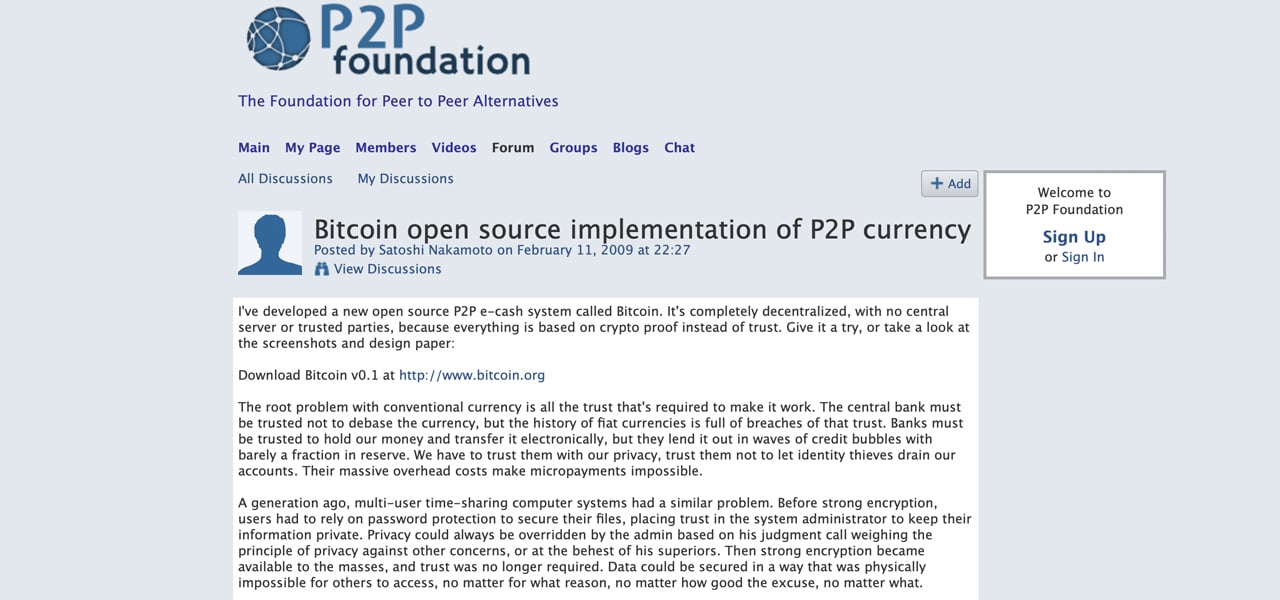
13 years ago today, the creator of the Bitcoin network, Satoshi Nakamoto published the inventor’s first forum post on the P2P Foundation website. The forum post called “Bitcoin open source implementation of P2P currency” introduced the e-cash system to the members of the advocacy and research forum focused on peer-to-peer dynamics in society.

The First of 3 February 2009 Forum Posts Introducing Bitcoin

There was three occasions in February 2009 when Satoshi Nakamoto introduced the inventor’s Bitcoin white paper and open source codebase to the P2P Foundation forum members. The occasion on February 11, 2009, was the first time the creator of Bitcoin publicly announced the project using the P2P Foundation forum. Prior to these instances during the month of February, Nakamoto leveraged the email system tethered to the cryptography mailing list hosted on metzdowd.com.

13 Years Ago Today, Satoshi Nakamoto Published the First Forum Post Introducing Bitcoin
On February 11, 2009, Satoshi Nakamoto published the first introductory forum post about the Bitcoin network.

The introductory forum post is quite fascinating, and the inventor also leaves a link to the software’s first version on the forum as well. “I’ve developed a new open source P2P e-cash system called Bitcoin,” Nakamoto wrote 13 years ago today. “It’s completely decentralized, with no central server or trusted parties, because everything is based on crypto proof instead of trust. Give it a try, or take a look at the screenshots and design paper,” the creator added.

Nakamoto is extremely descriptive in the first forum post, and Bitcoin’s inventor explains the issue with conventional currencies. “The root problem with conventional currency is all the trust that’s required to make it work,” Nakamoto wrote that day. “The central bank must be trusted not to debase the currency, but the history of fiat currencies is full of breaches of that trust. Banks must be trusted to hold our money and transfer it electronically, but they lend it out in waves of credit bubbles with barely a fraction in reserve.”

Bitcoin’s inventor further stressed:

Nakamoto Responds: ‘I Think This Is the First Time We’re Trying a Decentralized, Non-Trust-Based System’

Anyone who reads the first forum post Satoshi wrote, can understand that the inventor is trying to get the word out, so more people can test the Bitcoin network during the earliest days. Nakamoto’s forum post did not get a reply until the very next day, as an individual named Sepp Hasslberger was the first to respond to Nakamoto’s first P2P Foundation thread.

“Great stuff,” Hasslberger wrote at the time. “This is the first real innovation in money since the Bank of England started to issue its promissory notes for gold in the vaults, which then became known as banknotes. I believe an open source currency has great potential. A bit like Google becoming the default search engine for many of us,” Hasslberger added. A few other individuals in the post talked about “old Chaumian central stuff” and e-currency projects such as e-gold that failed in the past.

Satoshi responded to a few questions in the thread and noted that the “old Chaumian central mint stuff,” was the only thing available at the time. Bitcoin’s inventor reminded the P2P Foundation members that the Bitcoin protocol was decentralized and different. “A lot of people automatically dismiss e-currency as a lost cause because of all the companies that failed since the 1990’s,” Nakamoto replied to one of the thread’s responses on February 15, 2009. “I hope it’s obvious it was only the centrally controlled nature of those systems that doomed them. I think this is the first time we’re trying a decentralized, non-trust-based system,” the cryptocurrency’s creator added.

On February 18, Nakamoto came back to the thread to answer multiple questions asked by inquisitive Sepp Hasslberger at the time. In response to Hasslberger’s questions, Nakamoto laid out three interesting features the Bitcoin network showcased and insisted that the coins would be scarce. Nakamoto said:

It is a global distributed database, with additions to the database by consent of the majority, based on a set of rules they follow: [One] — Whenever someone finds proof-of-work to generate a block, they get some new coins. [Two] — The proof-of-work difficulty is adjusted every two weeks to target an average of 6 blocks per hour (for the whole network). [Three] — The coins given per block is cut in half every 4 years — You could say coins are issued by the majority. They are issued in a limited, predetermined amount.

It’s safe to say that Satoshi Nakamoto’s e-cash system caught on and after 13 years, 18,954,937 bitcoins have been issued out of the maximum supply of 21 million so far. Bitcoin’s (BTC) market capitalization is currently worth more than $800 billion and since its inception on January 3, 2009, the network has been functional with a 99.98713391230% uptime rating. Nakamoto’s invention has also sparked the creation of thousands of crypto coins, and today there’s 12,523 crypto assets within the crypto economy.

What do you think about the first forum post written by Satoshi Nakamoto on the P2P Foundation forum? Let us know what you think about this subject in the comments section below.