Powered By Blogger

Tuesday, 29 June 2021

CoinMarketCap, Seedly and Gemini Release ‘State of Crypto in Singapore’ Survey

For crypto enthusiasts in Singapore, take our survey to get a chance to win a little bit of crypto — but more importantly, to help map crypto use in the country!


CoinMarketCap, crypto exchange Gemini and personal finance site Seedly have teamed up to launch a survey for Singaporeans on the state of cryptocurrency in the country.

For crypto enthusiasts (and those new to crypto!) in Singapore, you can take our joint survey here about your relationship to cryptocurrency from Tuesday, June 29 at 12:00 SGT through July 9 at 23:59. 

Singaporean participants that complete the survey will be entered in the chance to win over $7,000 in rewards.

The first 1,000 survey participants will be up for a $5 GRAB voucher, one lucky participant will win $300 in ETH, 45 participants will be up for $20 in ETH, and several other prizes are also up for grabs.

If you’re from Singapore, and you’re interested in crypto or personal finance, what are you waiting for? Take the survey here.

This article contains links to third-party websites or other content for information purposes only (“Third-Party Sites”). The Third-Party Sites are not under the control of CoinMarketCap, and CoinMarketCap is not responsible for the content of any Third-Party Site, including without limitation any link contained in a Third-Party Site, or any changes or updates to a Third-Party Site. CoinMarketCap is providing these links to you only as a convenience, and the inclusion of any link does not imply endorsement, approval or recommendation by CoinMarketCap of the site or any association with its operators. This article is intended to be used and must be used for informational purposes only. It is important to do your own research and analysis before making any material decisions related to any of the products or services described. This article is not intended as, and shall not be construed as, financial advice. The views and opinions expressed in this article are the author’s [company’s] own and do not necessarily reflect those of CoinMarketCap.


CoinMarketCap Launches Token Swaps

CoinMarketCap has launched their new token swap feature — swap your favorite tokens, right on CoinMarketCap.


CoinMarketCap is known as the number one place for crypto enthusiasts around the world to check the price of any cryptocurrency. However, what if you check the price of a token on CoinMarketCap that you already own in a wallet, and are struck with the urge to swap it?

As of today on CoinMarketCap, users can actually swap the tokens whose prices they had been admiring (or bewailing). 

That’s right — CoinMarketCap has launched a token swap feature.

On every supported network and token, you will be able to connect a supported crypto wallet and swap your tokens right on CoinMarketCap in a safe and secure way.

At launch, Uniswap (V1 and V2) will be the first supported DEX for token swaps. 

What Networks, Wallets and DEXs Does CoinMarketCap TokenSwap Support?

Below is a list of the currently supported DEXs, wallets and networks.

Supported DEXs

Uniswap.

Supported Wallets

At this time, wallets supported by Uniswap will also be available for the CoinMarketCap token swap. This includes MetaMask, WalletConnect, Coinbase Wallet, Fortmatic and Portis.

Supported Networks

Ethereum is the network supported at this time

How to Use Token Swaps on CoinMarketCap

First, navigate to the page of the coin that you wish to swap. You will see a converter between a selection of two coins on the right side of the page, and the option to “Swap on CoinMarketCap.”

Once you click to swap, you will be able to select the cryptos that you wish to swap and the amount. At this point, you will need to connect a wallet and sign the blockchain transaction. 

Make sure that you have checked the liquidity provider fee that will be charged, the route, the price impact, the minimum received and the slippage tolerance before confirming your swap.

For more information about token swaps in general, see our CoinMarketCap Alexandria beginner’s guide to token swaps.


Which Country Will Make Crypto Legal Tender Next?By CoinMarketCap

CoinMarketCap's new feature lets our users guess which country will accept crypto as legal tender next.


The whole world watched when El Salvador made Bitcoin legal tender within the country — but which country is next in this path of crypto adoption?

Now, with CoinMarketCap’s new legal tender prediction feature, you can make up to three predictions about which country or region will make cryptocurrency legal tender next. Remember, once you make your prediction, you can’t undo it!


For up to three predictions, CoinMarketCap users will receive 10 Diamonds as part of the CoinMarketCap Diamonds loyalty rewards program. If one of these predictions turns out to be correct — you will win 50 Diamonds!


Myriad Proof-of-Work Blockchains See Significant Hashrate Losses


While there’s been a lot of concentration on bitcoin mining crackdowns in China and Bitcoin’s recent hashrate loss on Monday, many other digital assets have seen hashrates drop significantly as well. Some of the largest digital currencies, in terms of market valuation, lost considerable dedicated hashpower over the last few days.

PoW Chains Feel the Wrath of the Great ASIC and GPU Exodus

Lots of crypto advocates have been focused on China and Bitcoin’s (BTC) hashrate losing a large percentage of hashpower. Data shows on Monday, June 28, that BTC’s hashrate did drop considerably, but intraday statistics are not as reliable as they will be in five to seven days.

Myriad Proof-of-Work Blockchains See Significant Hashrate Losses
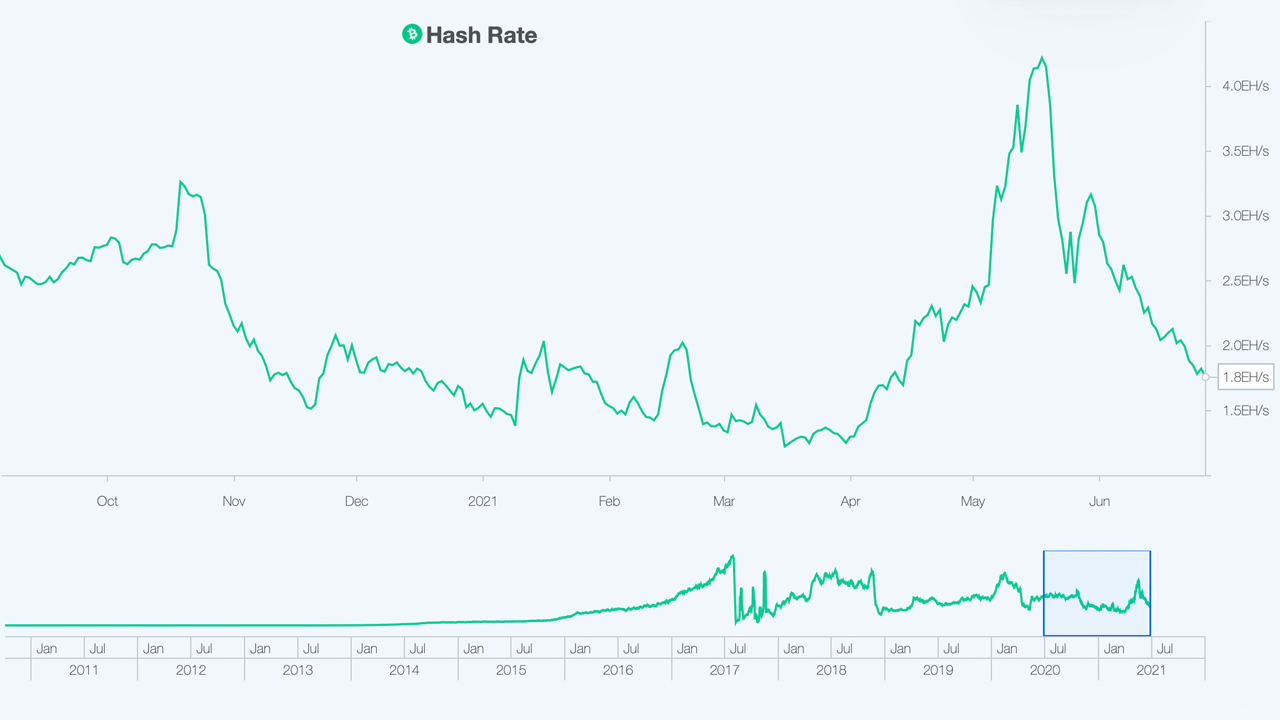
Bitcoin Cash hashrate on June 28, 2021.

Estimates show BTC’s intraday hashrate drop was over 35% but this metric may be recorded differently by the end of next week. There’s been a huge focus on the BTC chain’s hashrate, but no one’s talking about a large number of other blockchains that secure their networks using proof-of-work (PoW) losing considerable hashpower as well.

For instance, on Sunday, June 27, Monero’s (XMR) hashrate was around 2,580 megahash per second (MH/s) or 2.58 gigahash per second (GH/s). The following day, XMR’s hashrate slipped to 2.36 GH/s losing 8.52% of its intraday hashrate.

Hashrate on the Bitcoin Cash (BCH) chain was above 2.5 exahash per second (EH/s) during the first week of June. Nevertheless, on June 22, it dropped to a low of 1.15 EH/sBCH hash has jumped back some, and hovers just below the 2 EH/s region at time of writing.

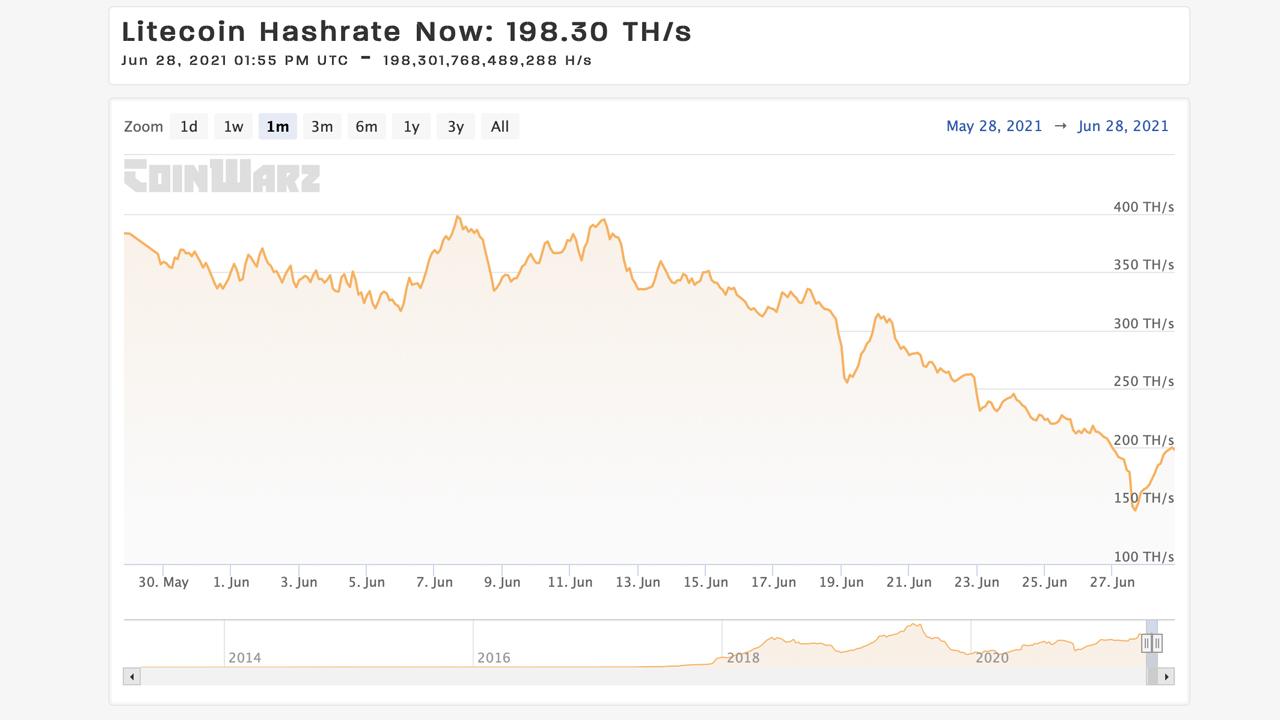
On Saturday, June 26, Litecoin’s (LTC) hashrate was around 218 terahash per second (TH/s) and it slid to a low of 145 TH/s on Monday morning (EDT). LTC’s hashrate has kicked back up to 197 TH/s, but it’s still down 9.63% since Saturday.

Myriad Proof-of-Work Blockchains See Significant Hashrate Losses
Litecoin hashrate on June 28, 2021.

Dash had 6 petahash per second (PH/s) on Sunday afternoon, but on Monday the DASH hash rate was down 34.5% intraday at 3.93 PH/s. Hashrate has dropped on the Ethereum (ETH) blockchain, Ethereum Classic (ETC), Zcash (ZEC), and many other PoW chains.

Some consider blockchains like Dash’s consensus mechanism a modification of the proof-of-stake (PoS) and PoW algorithm, because the chain also leverages masternodes and LLMQ-based Chainlocks. The Ethereum chain is also in the midst of transitioning to a full PoS chain but it also uses a mixture of PoW at the moment.

Myriad Proof-of-Work Blockchains See Significant Hashrate Losses
Ethereum hashrate on June 28, 2021.

While these coins do use PoW, they leverage different consensus algorithms, which means different application-specific integrated circuits (ASIC) and graphics processing unit (GPU)-driven machines are needed to mine these coins.

BTCBCH, and BSV all share the same SHA256 algorithm but there are many other PoW algorithms like Scrypt (dogecoin, litecoin), Randomx (XMR), Ethash (ETH), Blake (DCR), X11 (DASH), and Equihash (ZEC). Since the crackdowns in China, any coin with a hashrate pulse has felt the pressure of the great ASIC and GPU exodus.

What do you think about all the crypto asset networks that have lost considerable hashrate in June? Let us know what you think about this subject in the comments section below.

Mysterious Bitcoin Maximalist Mircea Popescu Allegedly Found Dead


Mpex founder and Bitcoin evangelist Mircea Popescu reportedly drowned off the coast of Costa Rica, adding to the mystery surrounding the man, his purported bitcoin fortune, and what it might mean for the future of the network.

Father of “Bitcoin Toxicity” Faced No Shortage of Controversy

Just like the pseudonymous Satoshi Nakamato sparked a thrilling hunt for the true identity of the person or persons behind Bitcoin, the network has reportedly lost one of its most enigmatic and polarizing figures of the last decade.

Mircea Popescu, a Romanian national and noted Bitcoin maximalist who promised to dump over one million bitcoins if block sizes were adjusted, supposedly drowned off the coast of Costa Rica on June 23rd. Confirmation of his passing has been scant, with outlets originally reporting that a Polish national had drowned.

A relatively mysterious figure within the community, little is known about Popescu apart from his blogging on Trilema, support for security-focused open-source projects, and dedication to keeping the Bitcoin network unchanged despite calls for bigger block sizes.

After blogging on cryptocurrency in its early years, he founded bitcoin exchange Mpex in 2012, which later became the target of a US Securities and Exchange Commission (SEC) investigation. Satoshi DICE, a popular gambling website that only accepted bitcoin, was listed on Romanian-based Mpex by Eric Voorhees.

Eventually, the listing became a part of the SEC investigation after the offering was not approved by the regulator. Voorhees was later fined and forced to buy back the shares that were listed. During the situation, Popescu was famed for trolling the SEC, going so far as to post his correspondence with the enforcement team in his Trilema blog. His eccentricity was on full display as he set out to dismantle the SEC’s requests and lay bare the holes in their arguments for information about Mpex and client activities.

Despite the little known about his personal and professional endeavors, Popescu’s commitment to open-source systems is well known. After the open-source operating system Open BSD, which has been around since the 1990s, ran into funding issues, Popescu donated $20,000 in 2014 to keep the non-profit foundation behind the software running. Given the security-centric approach of the OS and Popescu’s leanings, Mpex also employed the technology in its platform.

Mired in controversy for years, Popescu left behind many quotes and sayings, some of which painted a fairly negative image of the man himself. Yet, none of his antics were taken so seriously as his promise to dump a million bitcoins in the market if changes were made to Bitcoin block sizes (this reportedly occurred in 2016), earning him the moniker “Father of Bitcoin Toxicity.” Eventually, Segwit2x, an initiative designed to double the block size to 2MB, was abandoned and cemented the network’s use of the 1MB block size.

Despite never being confirmed, it was inferred that Popescu actually did command control over that vast swathe of a million bitcoin, which, if true, made him likely the only bitcoin millionaire (owner of more than one million coins). However, this figure was never confirmed. It did create concerns in light of his alleged death, though, that one million bitcoins could hit the market and cause prices to careen lower.

For now, the situation remains shrouded in mystery amid the lack of formal confirmation of his passing.

What do you think will happen with Mircea Popescu’s bitcoin fortune? Let us know in the comments section below.